Saturday, 4 February 2023

Youtube's copyright system - some suggestions

 A lot of virtual ink has been spilled on social media about Youtube's ways of juggling the competing demands of running a viable content platform and intellectual property (IP) protection. From users, influencers and companies no one is happy with Youtube's copyright system. Well, not quite, Youtube is very happy with how its copyright system works. Currently its safe harbour strategy and off loading of all the work onto the claimants and the targets of their claims works really well for the company. On the one hand, by taking as little direct action as possible the company can profit off piracy until the IP holders get off their haunches and take action themselves, and on the other it gets to put distance between it and the massive amount of copyfraud(1) that takes place on the site.

So far, despite some creaks the system has been working very well, the only real issue is when a big channel that has an equally large social media presence gets caught up in the cross fire and starts to cause a commotion. For years its been a joke that the best way to get Youtube to address a problem you have is to complain about it on twitter. The sad part? It isn't a joke, I've tried to get my issues resolved using the few official channels Youtube has and usually I can't even get a direct answer to establish what I've done wrong in the first place.

Unfortunately we won't see systemic change from Youtube, what few major changes like disabling adverts and comments on content intended for children came from legislation passed above the company. I've used Youtube since the early days and I've seen many changes over those years. I remember when Youtube had a private messaging feature and a video reply feature. And while many of those changes have been detrimental -a big one for me was removing community captions so speakers of other languages could add translations of content they enjoyed to help it connect with a wider audience as an example -there have been a few that were useful, and one or two that relate to Youtube's copyright system.

A brief example:

  1.  Soundtracks are the bane of any Youtubers existence, ignoring Copyfraud it turns out there are only so many combinations of chords and beats out there, and hundreds if not thousands of versions of the same song with different creators and IP statuses. I cannot count the times I've upload something only to be hit with a claim by the label for a song that was released fifty or sixty years after my upload was released. And even for content I created totally from scratch. So, one of the positive changes is the option to remove the audio in question, which damages the overall upload but is better than losing the whole thing. If you've ever watched a video where the soundtrack suddenly cuts off or its noticeably distorted for a bit before coming back that is probably what happen.
  2.  Another improvement in regards to sounds, Youtube now has a sound library of songs that can be used to replace claimed material. Now, there's a lot of room for improvement which I'll be getting to later but this is at least partially useful.
  3.  Adding an appeal function between disputes and counter notification is a good step, it allows you more room to explain your case if it was rejected the first time.

And that's about it. So, in the interest of making things a little better, I've come up with a few things that Youtube can do to improve the situation without jeopardising its position, if anything they would cement it by making the system be between claimants and defendants more viable.


  1. Add an option to the disputes for when someone files a claim for content on a video that does not in fact use that content. To explain a bit, when you get copyright claim or block or strike you no longer just get an e-mail informing you that ____ has made a claim against your video, it tells the content being claimed, audio or video, and it shows which part of the video is causing the problem, which could be the whole upload or a few seconds. And it tells you who made the claim (more on this later) and for what they're claiming the content originated from. i.e. Sony has claimed 00:52-01:23 of an upload claiming it belongs to a film they own released in 1983, as a random example. And then you can look at the claim and weigh up its merits and choose how to respond, cut, ignore or dispute. If you dispute you can't just open up a text box and explain your reasoning, you have to first select from some options, (see image above for an example) the issue here is that by making a selection it locks you into a specific argument. Choosing unwisely can cause you a lot of trouble. `You may think what's the problem since you run a public domain channel?` Well aside from intentional copyfraud an issue I run into on a semi-regular basis is content is claimed on a public domain video, but the claim is based on material that is not in the public domain. When that happens you're hamstrung, because arguing that your upload is public domain even with all the proof in the world is all well and good, but the claimant's don't really care about that they care about protecting and profiting off of there IP, so its a roll of the dice whether they'll bother to read your dispute if they know they own the rights to what they're claiming, in my experience they do not bother to look at the upload to check at best they skim what you wrote and decide how much trouble its worth to keep up the struggle. Adding an option to explain that the claim was made in error wouldn't change anything from Youtube's point of view its still up to the claimant to weigh up the merits, but it would mean that since the basis of the dispute has changed at least some IP claimants and copyfraudsters might give the argument more weight and be deterred.
  2. Make it so that claimants have to explain what exactly is being used. Currently you do not have an easy way of verifying if you have used or misused someone else's content. Most copyright claims are automatic and done via the claimant uploading their content to Youtube's content ID checker tool. And it already highlights which part of the timeline of a video its supposedly found a violation but that is it. Its up to you to check, which can prove impossible if you can't find what they're basing their claim on. This is especially true of music claims, usually you'll get a song name and an artist (but that's not guaranteed) and claimant's corporate name who is the usually the label but could be third party representing them. This makes tracking it down difficult and sometimes impossible. For music their are two important factors composition, its date of creation and creator and the specific recording its date of creation and creator. The old English anthem Jerusalem by William Blake is public domain, I could sing it and record it and then I have copyright on that specific recording. But, if I used Youtube's content checker it would not only flag up copies of my version, it would flag up many others which either belong to the uploader, were licensed, were used for criticism, or a public domain version. If I flagged your upload you would have to stumble upon my recording and figure out it is the version the claim is based on and then decide if I strong case or not. And that's when the claim is based on a song and not a melody claim(2), good luck figuring out if that has any basis. Usually I have to copy all of the information I can get from the claim, read through the credits on the upload to see if there's a match, if not I have to throw that information into a search engine and hope I can find something, and sometimes what I find still denies me important information. But its already in the content ID system, so Youtube absolutely could enable you to review and compare the claims within the copyright dispute panel. This would change nothing for Youtube since its the claimant who submits the media and uses it to pursue its claims.
  3. Make claimants explain why they feel their material is being violated. Currently the dispute process is entirely one sided, the defendant has to argue their case against a void that is the claimant. Which strikes me as fundamentally wrong, it assumes guilt and forces the targetted to argue innocence without specifically knowing what the issue is. The claimant has to have proof that they're the owner of the content being used or at least represent those that do, so they should no difficulty or objection to providing some proof. This would seriously weaken the rampant copyfraud that plagues Youtube.
  4. Make it clear which jurisdiction Youtube uses. Copyright is a messy and confusing thing, especially since there are more systems of copyright than there are nations under the sun. If you refer back to the image at the top, you will see an option for fair use, this would indicate that Youtube uses the copyright framework of the United States of America. It would help if this was made explicit and if Youtube could clarify its position regarding works of a non-US origin, does it still count their copyright or does it not? An alternative solution would be requiring copyright claimants to declare what legal basis (i.e. which territory or territories that claim is based on) so you can have some information to go on. Currently I have to deal with copyright owners, well alleged copyright owners in one nation or another blocking content worldwide which in the UK simply can't be done if its public domain in the UK, it does not matter what claim is being made elsewhere.
  5. Add an option to obtain a license to use content, this would ease some of the tensions over IP from both sides with both legitimate and illegitimate claims of piracy. While IP defenders talk at length about morality and the sacrosanctity of the creator 99% of the time they're after money, a bit of something is better than all of nothing and it would mean that users who rely on Youtube for income will have some more security even if they have to cut in an occasional false actor on work that should be free for them to use for whatever reason. This one is already very slowly being done with audio in the United States, currently Youtube is piloting a deal with some record labels to split revenue with the uploader and the label. Expanding this process while not particularly ideal, it offends me on moral grounds if I'm honest would at least ensure greater access to material and a reduction in fighting over the same material over and over.
  6. Make it public when an entity is confirmed to be a serial abuser of the copyright claims system. Copyfraud is technically illegal under many nation's copyright statutes including in the United States. However, I am not aware of any nation having a mechanism for punishment. Making it public when someone is caught abusing the system could be a deterrent against repeat offenders, and is already being done anyway informally using the complaining on social media.


______________________________________________________________

1: Copyfraud, put simply its were someone deliberately makes a false claim of ownership of work that is either public domain, an orphan work or belonging to someone else.

2: Melody claims are exactly the same as a standard audio claim, however instead of a specific version you can at least check against that version if you can find its information. For melodies you have little chance without the specific track in question being made available so you can check.

Friday, 13 January 2023

Countdown to Mickey Mouse entering the public domain


Mickey Mouse becomes Free


On the 1st of January 2024 after decades of intensive lobbying Mickey Mouse will enter the public domain. His first appearance the 1928 animated short Steamboat Willy will lose its copyright protection in its country of origin the United States of America and thus every other territory like the United Kingdom that has the rule of shorter term and country of origin. 


Still from Mickey Mouse and the Mad Doctor


 Of course several Disney products have already entered the public domain because registrations weren't renewed and for works contracted to the United States government during WWII. And this includes some works that feature the Disney Empire corporation's mascot and superstar Michael `Mickey` Mouse. If you come across a collection of comic strips called "Uncensored Mouse" that is a collection of Mickey Mouse comic strips that are in the public domain. The importance here is that when a character's first appearance enters the public domain it frees up that character for re-use in many creative ways, whereas previously we were limited to the handful of works that were in the public domain. 

Though its important to keep in mind that Disney will retain copyright on many later works documenting the Mouse and his adventures, we'll have trademarks to deal with, but this is still a big deal.

Sunday, 8 January 2023

On Inheritance

 Its a new year, and already I can see a few entries on my updated FAQ. Intellectual Property as a concept stands on very shaky ground. In order to stigmatise the sharing and copying of IP corporations and government trading boards spent a lot of time and money comparing violators to pirates and petty thieves, ignoring the obvious question of what exactly is stolen from copying?

Overall its an ideological battlefield that can be only kept going through constant resource expenditure. Essentially keep the arguments in the public consciousness and eventually people will grow accustomed and accept them. One of the few areas were IP protections has had some success is the argument of inheritance. There are many copyright systems in use across the world, the only thing they have in common is that they all have terms of exclusivity that outlive their creator. Now this flies in the face of the majority of the "Moral" argument for IP which centres on creative types who are passionate individuals and not faceless entities. The implication being that the copyright system is actually for the protection of these noble struggling artists. But if that were the case we can ask why do most copyright legislation models allow corporate entities to buy up these rights? And why is it nearly always a corporate body pursuing protection and adressment of suspect IP violations? And why have copyright after the death of the creator(s)? What possible use could that be to a corpse?

The answer to these questions is usually to ignore all of them apart from the last one about post mortis rights. There the answer is for their heirs. The argument goes that life+ gives protection for the descendants of the author. Now, I'm in a minority who thinks inheritance of property and the power and privileges that come with them do more harm than good, but you don't have to be a committed socialist to realise there are some problems with accepting this at face value.

To be blunt, copyright legislation and inheritance legislation are not the same thing, and when an IP passes onto another generation the credit goes to that country's inheritance customs and laws, not its copyright statutes. Copyright law doesn't say anything about who should get IP after the death of the principle creator(s) that is determined by contracts and courts. The only area where copyright legislation does overlap with inheritance it is a detriment and not a boost. You may have heard of the concept of Orphan Work, and Orphan Work is a IP whose creator has expired, but, there is no clear inheritor, neither familial nor commercial. This means that works that are Orphaned legally can not be touched at all and must wait out the term before it can enter the public domain for use and reuse. This has meant that a large body of work is condemned to rot for decades and its a major cause for the growth of lost media.

If you're a creator and you wish for your descendants to profit from your labour than you are within your legal rights. However, your copyright will not help with that, you will need to consult a lawyer and draw up a Will. For example, Arthur Conan Doyle drew up a Will that mentions how his estate was to be divided up and disposed off after his passing. He does discuss his IP in that document.

His MSS. to his wife, directing that the executors should "deal as they think best with copyrights, plays, cinema rights, or unpublished MSS.," and directing that the income from them should be regarded as income from his residuary estate.

[Italics in original]

This is relevant because the heirs to Conan Doyle are quite infamous for their predatory business practices using their ownership of the Sherlock Holmes IP in the United States of America. Which they've lost this January. While many have decried their actions very few have criticised or challenged their "Moral right" to behave in such a horrible way. Because many assume that it was Conan Doyle's wishes that his beloved creations would remain with his family. But if you read his will he regarded IP as simple business matter to be handled along with his savings and personal properties. Its the actions of the Executor that meant his family maintained control over the IP for so long not Doyle's personal wishes.

But even with a Will its still not guaranteed, Wills are contested quite regularly and if a strong enough case can be brought up. For example are you familiar with the Millennium series of books? Well Stig Larsson the author of the first three, The Girl with the Dragon Tattoo, The Girl Who Played With Fire, The Girl Who Kicked the Hornets Nest. Well, Larsson died in 2004 and he had a Will. In it he declared his desire that the proceeds from his IP his royalties should go to a small Trotskyist party in Sweden, which is a bit unusual but it was his Will. However since the Will hadn't been witnessed it was declared invalid by the courts, and they instead awarded his estate to his father and brother, the court also ruled that Larsson's long-term partner was ineligible for funds because they had not married. What this means is Larsson's copyright and stated wishes were secondary to the laws of his country which have entrenched customs and requirements. No one disputes Larsson's copyright nor what his wishes were, he just didn't conform to the requirements of the Swedish legal system who overruled him.  

Stig Larsson isn't the only example of this nor even a particularly rare one, he's just the example that comes to my mind every time I see someone praise copyright for the benefits of inheritance. Again the corporations that defend copyright after the deaths of directors and authors aren't doing it to be kind and charitable, they're doing it because they own that IP and not the grieving family. 

Sunday, 20 November 2022

Frequently Asked Questions

Promoting public domain work can be a frustrating process. This is by design, the drafters of intellectual rights legislation and customs directly profit from a state of confusion that keeps the general public in the dark and constantly questioning what is and is not allowed, and who does or does not own what.

Over the years I encounter the same questions over and over and over and over again. In attempt to add a little more clarity to the issue I'm sketching out some of the more common questions I've come across.

Disclaimer: This is not legal advice, please consult a relevant legal authority if you are involved in any kind of dispute.

Additional note, there is no universal standard for copyright, there is a policy that has been adopted by the majority of the nations of the world but not all, and even amongst these, there are nuances to how it is applied in each territory. I am most familiar with the copyright system in the UK and USA, if you or the work in question does not originate within these two territories you will have to look elsewhere for specific advice for your country of origin.

  1. What's the difference between Trademark (TM) and copyright (C)?
    While these two often get confused a lot separates them. In brief, copyright is the right of ownership, while trade mark applies to branding. Of the two TM is far weaker than copyright, and while copyright is automatic a trade mark has to be continually enforced. A key misconception is that copyright also requires constant enforcement, it doesn't. The only way to lose copyright is for the term to expire or for the owner to give it up. Not actively protecting copyright, or only selectively protecting copyright is at the discretion of the owner.
  2. How can X use Y when Y is still trademarked?
    This one shot up in popularity this year (2022) after Disney's copyright on Whinnie the Pooh expired. Since Disney is still trademarking the character and many products with the character and his friends in the first book, the news of various knock-offs and in particular the announcement of a horror movie starring the bear and piglet has sparked a lot of confusion. The key to a Trademark is that it is weaker than copyright. Specifically, an active Trademark doesn't mean no one else can use the trademarked property if the copyright is invalid, to be considered a trademark violation the claimant has to demonstrate that the alleged violators product could be confused with a product or service currently trademarked by the claimant. I don't think there are many people who would confuse a live action horror flick for a Disney product. An animated kids movie with Jim Cummings doing the voices would be a different matter. Another example in the European Union, the mobile game Candy Crush, successfully trademarked Candy Crush. You still use those words, though calling a mobile game that would be potentially vulnerable. 
  3. [Questioner is American] If things made in 19__ are public domain how come [product made by a non American who died decades after the 19__s] isn't public domain?
    Because there is no universal standard for copyright. The 95 years after creation term applies solely to content created in the USA. If the work was created in another country that country's copyright law is what matters, this is called country of origin, most copyright systems account for it. The United States didn't until the 1990s when it retroactively added a vast sum of art that had been public domain in the United States back into copyright. The UK has country of origin, so if a work is public domain in its country of origin, then that is true for the UK, but if it is not but the life of the author and 70 years has passed than it is also public domain in the UK.
  4. If works in the USA are public domain after 95 years how is this tv show from 1973 public domain? 
    Because the USA has one of the most convoluted histories with copyright. The 95 year term is modern development, throughout the 18th, 19th and most of the 20th century America used a registration system, and to make it more confusing they kept passing laws that changed requirements for registration, renewal and terms of protection. As a result, their are a lot of books, movies etc, made well into 1960s and later that are public domain, either because they failed to register correctly, Romero's Night of the Living Dead, is the most famous example of this, or because no one bothered to renew them when their terms were up.
  5. X must still be copyrighted, so why is it shared so freely and included in loads of public domain lists?
    Well, back to confusion again. Looking at many lists of public domain material you're bound to find something that must still be in copyright. But as property has developed its increasingly difficult to say for sure without access to sensitive and confidential legal documents. In theory copyright is very clear, its the right of the creator to their work. But copyright can be bought, sold, and given away. This is why most copyright disputes aren't between two people, but between corporate entities. So, this complicates matters extraordinarily. So this may mean that the work in question is public domain after all because the entity that bought it didn't register or renew correctly, or more likely, no one knows who owns it so it has fallen into a limbo called orphan work.
  6. What's an orphan work?
    An orphan work is a work without an owner. Works published anonymously fall under this category and most copyright legislation accounts for it in some manner. They aren't public domain, but there isn't anyone to defend the copyright. You can't initiate a claim on behalf of someone else, that's another form intellectual property theft called copyfraud. However, increasingly orphaned works are works published by one or multiple private entities and they are orphaned because it just isn't clear who amongst them actual owns what and in what capacity they can use the work in question. Video games have a term called Abandonware, where games and their associated intellectual property just stop being active, largely because of this issue. Many video games are created through the input (or meddling) of multiple corporate partners, and all of them whether in development or in publishing will have a stake of some kind within it. Add in how common it is for video game and software companies to be bought out, merged, split off etc, and there are now multiple properties that can't be touched unless a dozen entities come onboard. 
  7. I want to use something that is still partially copyrighted, will X be okay?
    This is a unique feature of America's copyright system. In the UK and much of the rest of the world its a none or all situation. X years after death of creator all works are free to use. In America currently its a year of creation of individual works. So there are estates that are powerless in the rest of the world that still have teeth in the USA. The estate of Arthur Conan Doyle is a particularly infamous example with its actions to strong arm Sherlock Holmes adaptations since the last few short stories are still copyrighted there. These questions can only be answered by the estate holders themselves, its pointless to ask a third party, we don't know how other people will act.
  8. Is Creative Commons like Public Domain?
    No. Creative Commons is a licensing agreement, to know if and how you are allowed to use a work licensed under a Creative Commons license you will have to check what license it is and the requirements. To learn more about Creative Commons and the specific licenses go here.
  9. This has a copyright notice, how is it public domain?
    Well, in most of the world the ubiquitous small c in a circle is superfluous. Copyright is automatic so it doesn't really do anything. For example, me writing these words and then clicking publish is enough to ensure my copyright over this blogpost. Yes that's right, you own your posts, including on social media like facebook, twitter, and reddit and so on. In the UK the copyright notice on film and television programs serve only to inform us when the show was produced and to help us practice our Roman numerals. In the United States, one of the few territories where the circle c was necessary, it formed only part of the registration process. If you didn't include a visible copyright notice or an incorrect copyright notice your copyright was void. However, a correct copyright mark on its own was not sufficient to register the work for protection. The US copyright office is supposed to include and entry for all works that were copyrighted. This is partially searchable though it is a major pain to do so. In short, if there isn't a copyright record or renewal record if one was needed than the circle c means nothing.
  10. This is copyrighted in my country, why are you saying its public domain?
    I don't live in your country, and that's the status of my territory and the laws I'm supposed to follow. I'm not responsible for your conscience or actions.
I'll leave it here for now. There are a few more questions, but they aren't as frequent, for now anyway. If that changes I'll write up a follow up. Hopefully this is informative and helps pierce the fog of confusion just a little.


Wednesday, 9 November 2022

1944: Hell Bent for Election


Political advertising is pretty dire, its the most transparent of advertising, "give us your vote and in exchange you will have x" so this short 1944 animation was pleasant surprise. While still extremely blunt it uses clever imagery and a simple plot with a hero and a villain. If I didn't know FDR was a real person and President or about WWII I might have thought this was a cartoon morality story. Well, the cheering for the "win the war special" train that is armed to the teeth would've made for a strange moral.


This short was the first major work of United Productions of America, then still known by its boring name Industrial Films. It was funded by United Auto Workers and the Congress of Industrial Organizations, two powerful American labour organisations. The short is an openly pro Franklin Delano Roosevelt campaign film during his bid to be re-elected President in 1944. He won by a comfortable margin, it was the last election campaign he ran as he died in 1945. His opponent Thomas E. Dewey I had not heard of until watching this film, unless you count Truman holding up the newspaper with the infamously incorrect headline. So I don't know how accurate the caricature of Dewey's positions were. 


But in a vacuum, my sympathies lie more with Roosevelt based on the argument of the film. The workers struggling against a candidate supported by a businessman who has fascist sympathies, its not a hard choice really. One detail I enjoyed was that during the presentation of Dewey's social policies, or rather lack of policies, the music accompanying the scene is a rendition of the Preacher and the Slave, a popular labour song written by Joe Hill an important organiser for the Industrial Workers of the World, untill his death by firingsquad in 1915. 

So an ashamedly partisan piece, but the sequences and images were quite clever and well thought out. The hallucinations of the rail worker and the increasingly demonic capitalist out class thousands of political cartoonists. Though given that United Productions of America was founded by ex-animators for Walt Disney who parted ways with him after the 1941 cartoonists strike I'd hazard a guess that they had some personal experience with a similar tycoon with some interesting political views.

Friday, 28 October 2022

Imperial propaganda - The House that John Built


 The British Empire dominated much of the earth for several hundred years. To some this statement is a strange source of pride, an attitude of toxic superiority. For others this is something to feel embarrassed about. What's strange to me is that the Empire is barely talked about in modern Britain, its legacy is inescapable, but outside of history modules and specialised programming and literature its relegated in general discussions to vague mentions, this is true for positive (usually something about trains and ending slavery) and negatives, war, occupation and slave trading etc. 

So this short piece of early British animation The House that John Built is very interesting to me. Produced in 1928 by the Empire Marketing Board, the short was deisgined to have a wide audience, and was a forum for the Empire to justify and promote itself. I was surprised how it chose to do it. In this short Britain and the Empire are shown in purely economic terms. The greatness of both is shown first in their agricultural and cattle production, and then cemented by translating that bounty into a value in Imperial pounds. No talk of civilisation, or global stability, just animals representing statistics that showed annual growth in exports and imports. 

The Empire is great as it is a great system for the growth of capitalism. You have doubts about our Imperial accomplishments? Nonsense! Just look how well the pork markets were doing in 1925. The House that John Built is not an isolated endeavour. The Empire Marketing Board sponsored many marketing pushes to drive home the economic power of the Empire and to encourage purchasing. Economic patriotism from Canada to Australia, Nile to Cape Town. Looking back I find this revealing, while the talk of civilising the wild lands, and building technological progress have lingered on in the popular imagination, its clear from looking at the evidence of the time that as far as the Empire builders were concerned, the Empire was first and foremost a means to do business and enrich themselves. 


Sunday, 2 October 2022

The Recent Rising in Warsaw - George Orwell

Insurgents from "Kiliński" Battalion shoot at "PAST" building from the barricade on Zielna Street. 
October 2nd 1944 marks the final day of fighting in the uprising of Warsaw. The insurrection lasted two months, Polish resistance held much of the capital city and even managed to capture several German tanks and armoured cars and artillery escalating the battles from barricade fighting and rooftop sniping. 

The defeat came while the Red Army of the Soviet Union stood by at the outskirts of the city. Stalin's plans for post-war Poland benefited from the exhaustion of the Polish underground. The British establishment was also less than enthusiastic with this explosion in opposition to the Axis powers in Europe. George Orwell was working on what would become Animal Farm and was also writing articles for the left-wing newspaper Tribune. His article was one of the earliest reactions to the tragedy.


The Recent Rising in Warsaw


 It is not my primary job to discuss the details of contemporary politics, but this week there is something that cries out to be said. Since, it seems, nobody else will do so, I want to protest against the mean and cowardly attitude adopted by the British press towards the recent rising in Warsaw.

As soon as the news of the rising broke, the News Chronicle and kindred papers adopted a markedly disapproving attitude. One was left with the general impression that the Poles deserved to have their bottoms smacked for doing what all the Allied wirelesses had been urging them to do for years past, and that they would not be given and did not deserve to be given any help from outside. A few papers tentatively suggested that arms and supplies might be dropped by the Anglo-Americans, a thousand miles away: no one, so far as I know, suggested that this might be done by the Russians, perhaps twenty miles away. The New Statesman, in its issue of 18 August, even went so far as to doubt whether appreciable help could be given from the air in such circumstances. All or nearly all the papers of the Left were full of blame for the émigré London Government which had ‘prematurely’ ordered its followers to rise when the Red army was at the gates. This line of thought is adequately set forth in a letter to last week’s Tribune from Mr G. Barraclough. He makes the following specific charges:

  1. The Warsaw rising was ‘not a spontaneous popular rising’, but was ‘begun on orders from the soi-disant Polish Government in London’.

  2. The order to rise was given ‘without consultation with either the British or Soviet Governments’, and ‘no attempt was made to co-ordinate the rising with Allied action’.

  3. The Polish resistance movement is no more united round the London Government than the Greek resistance movement is united round King George of the Hellenes. (This is further emphasized by frequent use of the words émigré, soi-disant, etc., applied to the London Government.)

  4. The London Government precipitated the rising in order to be in possession of Warsaw when the Russians arrived, because in that case ‘the bargaining position of the émigré Government would be improved’. The London Government, we are told, ‘is ready to betray the Polish people’s cause to bolster up its own tenure of precarious office’, with much more to the same effect.

No shadow of proof is offered for any of these charges, though 1 and 2 are of a kind that could be verified and may well be true. My own guess is that 2 is true and 1 partly true. The third charge makes nonsense of the first two. If the London Government is not accepted by the mass of the people in Warsaw, why should they raise a desperate insurrection on its orders? By blaming Sosnkowski[1] and the rest for the rising, you are automatically assuming that it is to them that the Polish people looks for guidance. This obvious contradiction has been repeated in paper after paper, without, so far as I know, a single person having the honesty to point it out. As for the use of such expressions as émigré, it is simply a rhetorical trick. If the London Poles are "émigrés", so are the Polish National Committee of Liberation, besides the ‘free’ Governments of all the occupied countries. Why does one become an émigré by emigrating to London and not by emigrating to Moscow?

Charge No. 4 is morally on a par with the Osservatore Romano’s suggestion that the Russians held up their attack on Warsaw in order to get as many Polish resisters as possible killed off. It is the unproved and unprovable assertion of a mere propagandist who has no wish to establish the truth, but is simply out to do as much dirt on his opponent as possible. And all that I have read about this matter in the press—except for some very obscure papers and some remarks in Tribune, the Economist and the Evening Standard—is on the same level as Mr Barraclough’s letter.

Now, I know nothing of Polish affairs, and even if I had the power to do so I would not intervene in the struggle between the London Polish Government and the Moscow National Committee of Liberation. What I am concerned with is the attitude of the British intelligentsia, who cannot raise between them one single voice to question what they believe to be Russian policy, no matter what turn it takes, and in this case have had the unheard-of meanness to hint that our bombers ought not to be sent to the aid of our comrades fighting in Warsaw. The enormous majority of left-wingers who swallow the policy put out by the News Chronicle, etc., know no more about Poland than I do. All they know is that the Russians object to the London Government and have set up a rival organization, and so far as they are concerned that settles the matter. If tomorrow Stalin were to drop the Committee of Liberation and recognize the London Government, the whole British intelligentsia would flock after him like a troop of parrots. Their attitude towards Russian foreign policy is not ‘Is this policy right or wrong?’ but ‘This is Russian policy: how can we make it appear right?’ And this attitude is defended, if at all, solely on grounds of power.

The Russians are powerful in eastern Europe, we are not: therefore we must not oppose them. This involves the principle, of its nature alien to Socialism, that you must not protest against an evil which you cannot prevent.

I cannot discuss here why it is that the British intelligentsia, with few exceptions, have developed a nationalistic loyalty towards the U.S.S.R. and are dishonestly uncritical of its policies. In any case, I have discussed it elsewhere. But I would like to close with two considerations which are worth thinking over.

First of all, a message to English left-wing journalists and intellectuals generally: ‘Do remember that dishonesty and cowardice always have to be paid for. Don’t imagine that for years on end you can make yourself the boot-licking propagandist of the Soviet régime, or any other régime, and then suddenly return to mental decency. Once a whore, always a whore.’

Secondly, a wider consideration. Nothing is more important in the world today than Anglo-Russian friendship and co-operation, and that will not be attained without plain speaking. The best way to come to an agreement with a foreign nation is not to refrain from criticizing its policies, even to the extent of leaving your own people in the dark about them. At present, so slavish is the attitude of nearly the whole British press that ordinary people have very little idea of what is happening, and may well be committed to policies which they will repudiate in five years’ time. In a shadowy sort of way we have been told that the Russian peace terms are a super-Versailles, with partition of Germany, astronomical reparations, and forced labour on a huge scale. These proposals go practically uncriticized, while in much of the left-wing press hack writers are even hired to extol them. The result is that the average man has no notion of the enormity of what is proposed. I don’t know whether, when the time comes, the Russians will really want to put such terms into operation. My guess is that they won’t. But what I do know is that if any such thing were done, the British and probably the American public would never support it when the passion of war had died down. Any flagrantly unjust peace settlement will simply have the result, as it did last time, of making the British people unreasonably sympathetic with the victims. Anglo-Russian friendship depends upon there being a policy which both countries can agree upon, and this is impossible without free discussion and genuine criticism now. There can be no real alliance on the basis of ‘Stalin is always right’. The first step towards a real alliance is the dropping of illusions.

Finally, a word to the people who will write me letters about this. May I once again draw attention to the title of this column and remind everyone that the Editors of Tribune are not necessarily in agreement with all that I say, but are putting into practice their belief in freedom of speech?

George Orwell


___________________________________________________________________

1: Kazimierz Sosnkowski, Polish General and independence fighter, was made Commander in Chief of Polish armed forces in 1943 following the death of Sikorski.

Thursday, 29 September 2022

Pulgasari and North Korean copyright


Pulgasari is probably North Korea's most famous contribution to cinema internationally. This Godzilla homage has been overshadowed by the real life story of kidnapped South Korean director Shin Sang-ok and his ex wife Choi Eun-hee and how they used the promotion for Pulgasari as an opportunity to escape in Austria.

I reviewed the movie a long time ago . It's worth a watch if you're a Kaiju fan. There are better big monster movies but there are also much worse and its setting and themes are quite unique.


North Korea does have copyright, this may be surprising given how their country is heavily associated with industrial scale piracy and espionage. The rest of the so-called communist world also passed copyright laws and eventually took steps to conform to international standards including the Bern convention. North Korea took longer than most, its statute defining copyright was passed in 2001 with a period fifty years after the death of principle authors. They updated this policy in 2006 and I can't find anything in there about the legislation being retroactive. This means that much of its cultural and artisitc output was technically public domain immediately, though the isolation of the country and its limited economic activity outside of the Soviet bloc and the People's Republic of China meant that much of its output was not available. Pulgasari was an exception as it received a big push internationally. 

This combination of factors is why it's relatively easy to find subbed copies of the film floating around the internet and home printed dvds available in places like ebay. I believe that Pulgasari is one of the few films you could argue that lack of a robust copyright system did hurt its owners ability to make money. The film was a flop abroad but has since become a cult hit, but what money has been made from this resurgence in interest has been to South Korean and Asian small scale distributors and not the North Korea state. 

North Korea's ex-dear leader Kim Jong Il had been trying for years to build an internationally respected and financially viable cinema industry, and while it may sound silly the movie with a rubber monster costume was a key part of his offensive. In a way it's a good thing it failed and most of the money went into other pockets. The North Korean state would use those funds to secure itself and the film and television industry as tools for domestic control and foreign influence. They had already kidnapped South Korean film makers and the Japanese cast and crew of Pulgasari including Godzilla actor Kenpachiro Satsuma were lied to about shutting locations and brought to North Korea under false pretences. 

That's another issue with intellectual property rights, they're value neutral so it's perfectly acceptable that the owners are enriched and can use IP as a tool to win hearts and minds. In theory IP is for the benefit of struggling artists, but often the reality is that the beneficiaries are corporations with a strained relationship with ethics, or despotic governments.

Sunday, 4 September 2022

Property as right and commodity

 The term copyright is somewhat misleading. The copy part is still accurate but the right has become outdated. Originally pioneering authors like Victor Hugo fought for the right to decide how their works were used and adapted, but over the years the concept has exploded into a maze of confusing legalities and commodities to be traded and sold. 

Recently a case has come up that shows the distinction between copyright the ideal and copyright the reality. Youtube channel Business Casual (BCs) and its lawsuits against Youtube and the Russian state. They've made an informative video documenting the situation and their side of the dispute.

Given my stance on intellectual property it may be surprising that I'm somewhat sympathetic to BCs plight. It does seem that the Russia Today network has been taking their content and Youtube has been covering for them because they're good for Youtube's business. But I do find BCs incredulity at the situation especially their lamenting of a betrayal of "American Values" rather hard to sympathise with. How naive must you be to believe that businesses do anything but what's good for business (or more accurately, what they think will be good for business) when left to their own devices. Money has no nationality or morals.

This blatant unfairness is what motivates the majority of the people who support the free information and open culture movements. Copyright isn't a right that applies equally to all, it openly privileges the established wealthy and the legally entrenched. Its no surprise to me that Youtube supports big channels, for years its been a joke amongst users that the best way to get your channel restored and issues resolved is to complain publicly via a twitter count with a lot of followers. Its also no surprise that the judges found in favour of the clients with many powerful law firms. 

I face this issue all the time, multiple times a month my channel with get copyright claims on content I know is public domain as I've spent days and even weeks checking, and yet every time I challenge them I have to weigh the potential damage a lawsuit will do to me. I'm just an individual, these are companies with their own legal departments and some have well established reputations for being vindictive. This is ultimately the reality of modern day intellectual property, on paper you have a right but the real question is do you have the means to fight for it? If the answer is no than your right functionally does not exist.

BC is still working through their suit against the Russian government and has vowed to continue fighting Youtube, so they may eventually after much time and resources see some results, but they aren't exactly amateurs with a built in laptop and microphone. I hope despite BCs negative commentary in the above video, the channel owners will learn from this episode that copyright as it stands is fundamentally broken and join in the efforts to end the excesses.


Sunday, 21 August 2022

Canada to extend copyright by 20 years

 Canada is set to extend the term of copyright protection by 20 years to life of the author plus 70 years, whereas previously it was life of the author plus 50 years. This is disappointing news, in popular culture its common to joke about Canada being overlooked and insignificant compared to its neighbour the United States, but as a large economy with an extensive international network and an English and French speaking population they are a country of influence and importance. 

The reason for this change was the adoption of an trade agreement in 2020 the Canada-United States-Mexico agreement (CUSMA). In a nutshell the agreement pressured Canada into adopting a copyright system equivalent to the United States. So, the people of Canada are denied important art, culture and educational material to support international business. I would also like to mention that Mexico is a party to CUSMA too, and currently Mexico has possible the most restrictive intellectual property system in the globe, life plus 100 years. So, since Canada had to extend its copyright terms to match the United States at least that means we can look forward to a lowering of the term from Mexico to balance it out right?

Well CUSMA has spurred some reform legislation in Mexico, however as far as I can tell they have nothing to do with lowering the term of protection, and are instead focused on extending the power of copyright infringement take down notices and extending the use of digital locks. Once again we have a double standard in intellectual property rights, arguments from fairness to creator rights and even standardisation are just used as smokescreens to increase control over society by government's and global monopolies. 

Its not just Canada that's lost out it's the world. Come next year Canada will go through the same twenty year freeze that the USA did in the 1990s, which led to the loss of thousands of works and locked up gigabytes of information in university archives because they were orphan works. 

Monday, 8 August 2022

Private Enterprise and Public Property: On Boutique releases and other commercial activities


I've occasionally seen some hostility from people and groups that run for profit ventures using public domain material to other people using the same material. Accusations of piracy and financial damage and ingratitude. I mostly archive and share but on occasion have edited and cleaned up some films, removed watermarks, added subtitles and score, re-encoded to improve picture quality and so on. It can take a lot of time and energy. So I do understand and sympathise with others who have done some restoration work and feel they aren't being appreciated fully. 

But that said you can't dictate the attitude of the general public. IP projects also take a lot of work and time and even money to make, corporations are not people but the work they do involves quite a lot of people. So that the work is voluntary or for profit but on a smaller scale doesn't automatically command a set amount of appreciation. Though I do encourage people to make their appreciation more apparent if they do value or enjoy someone else's efforts, I can say from experience that it does make a difference.

As for piracy, I'm sorry but that's simply not applicable. Why is copying and sharing called piracy? 17th century Buccaneers didn't sail up to a Spanish trade Galleon in the Caribbean, copy it and its cargo and then sale it to port and let others do the same. They bore down and seized the ship with violence or the threat of violence and on occasion attacked the crew to boot. The reason why torrenting a e-book or sending friends mp3s over e-mail or a shared folder is called piracy is partly propaganda, while the violence of the pirates was exaggerated media corporations were keen to associate these practices with negative legacy of the black flag fleets. The justification for the connection was that while physically speaking nothing was being stolen, theft was still occurring because you were violating the intellectual property of the legitimate owners. And here's the thing with public domain works, since every single person is the owner of them, effectively speaking ownership dissolves as there is no way to enforce or define that relationship. 

While I'm sure it stings emotionally to see something you've worked on get shared in ways you didn't consent to, legally and in my view morally there's nothing that can be done. Cleaning up the audio or re-encoding to make the image a little crisper or submitting an alternate soundtrack (if that soundtrack is also in the public domain) doesn't entitle you to enforce exclusive access to it. So, no anyone calling a situation like this piracy either has been misinformed as to what piracy is, or is simply trying to use the power of shaming to make their case for them.

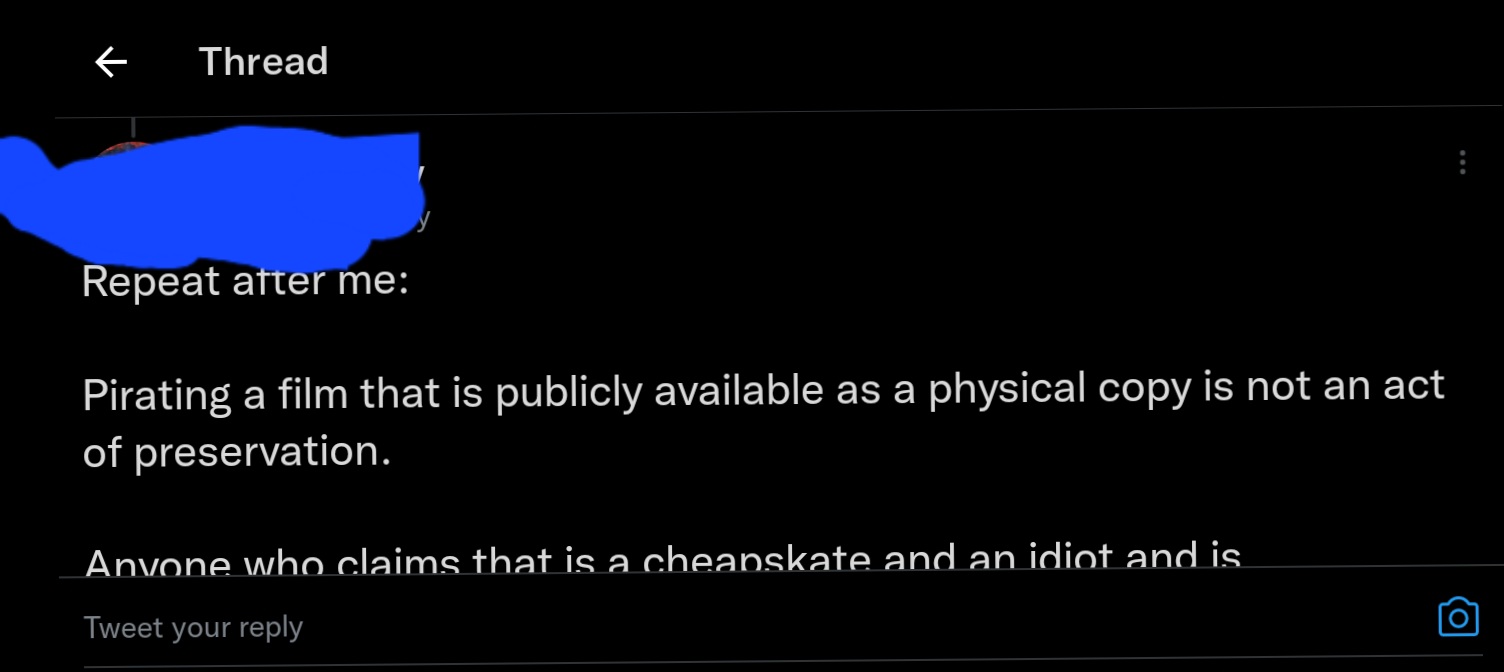
On the preservation angle that quite a few of these arguments revolve around. For profit boutique releases aid preservation and by impacting on their ways of making profit people threaten to make these things obscure and rare again. There are two major flaws here, first the onus is on them to provide evidence that these limited releases do improve preservation, I've personally eagerly awaited several of these releases, failed to get hold of a copy and seen the film go back into obscurity for years until someone rips their copy and starts sharing it on the web. A limited release at best provides a small chance that future generations will rediscover them at some point. If you make special editions or improved versions of old public domain films and seriously wish to support preservation the best thing you could do is send it to one of the major national archives like the Library of Congress or the British Film Institute, as they're the only ones with the resources and setup to maintain and preserve it with any degree of security for the future.

Many television shows that are lost partially or in their entirety sold there episodes in physical form to tv stations around the world, it was no protection from trashing, getting lost, wearing out, war and riots in some cases, censorship etc. 

And while we're on the subject, preservation for what purpose? If the object is simple create a physical product to keep locked away for ever, then preservation is a waste of time and resources. I find it to be much more worthwhile to preserve these films for the benefit of the public, which requires extensive sharing and duplication. There are many business practices that these limited and "boutique" producers employ that effectively shutout all but a few, or would do if we all respected their attempts to salvage a business strategy based on artificial scarcity.

Preservation is only one of the important functions of the public domain. The public domain does not exist so things can last forever, its importance is that in given ownership to everyone it enables everyone if they're willing to re-use and take inspiration from them to make new things and enrich culture further. To those who got into the public domain because they dreamed of becoming millionaires selling dvds of Chaplain and Buster Keaton and WWII cartoons, I'm sorry but you've picked a terrible business plan. It is possible to make money out of the public domain and seeking compensation for work and effort is no crime, but you have to accept reality, the only ones who can make a go of this are the bigger labels and even they use the public domain as an auxiliary source of income.

Labels

1770s (2) 1800s (1) 1810s (2) 1820s (1) 1840s (2) 1850s (1) 1860s (1) 1880s (4) 1890s (7) 1900s (7) 1910s (11) 1920s (19) 1930s (15) 1940s (13) 1950s (5) 1960s (4) 1970s (6) 1980s (1) 2000s (2) 2010s (1) 2020s (5) Activism (1) Adverts (1) Animation (8) archive matters (1) Canada (1) cartoons (6) comics (5) Copyright Reform (2) Disney (6) Documentaries (3) Drama (2) Essays (46) Europe (1) Fantasy (4) Film (21) George Orwell (10) Germany (3) Greta Garbo (1) horror (4) images (19) Japan (1) letter (1) LGBTQ (1) Maps (1) music (2) news (2) Newspapers (2) Newsreels (3) Noir (1) Open Media (3) pamphlets (5) patents (3) photography (1) poetry (8) Reviews (4) Robert frost (1) Romance (2) Science Fiction (5) Silent (3) texts (42) thrillers (1) trademarks (2) translation (1) UK (6) Videogames (3) War movies (3) Westerns (1)