 |
| Happy May Day |

 |
| Credit to No Bonzo |
There was a country where Common-sense had somehow got the upper hand. In that country sense was as common as lunacy is in a madhouse. There was a place for everything, and everything was either in that place, or else was on the direct way there—the shortest way, the easiest way, the cheapest way. In that country everybody was brought up with the notion that the simplest plan in everything served everybody’s turn best, even the clever people’s; and it was taken as a matter of course that if things did not go wrong people wouldn’t. They read in their books of history and comparative sociology that in countries were things do go wrong, people go wrong too, in the blind, blundering attempt to straighten things back a bit. But in Common-sense Country it was always said when things went wrong that there had been some nonsense—that is, empty word-play—in the heads or habits of the people, which had diverted attention from realities, and caused the people to let things wander out of the way.
In Common-sense Country all the commodities and goods, all the instruments, utensils, and appliances—in short, all the “things”—had very simple and unadventurous biographies, and, if they could have spoken, they would not have had much harrowing information to impart about the ravages of their tissues and textures caused by moth and rust, nor yet of vicissitudes incurred at the hands of thieves breaking through to steal. “I was needed: I was made: I was conveyed: I was applied: I was consumed.” That would have summed up the history of a thing in the country where things went right: only five short chapters. In most countries, of course, all sorts of distressing and distracting other chapters intervene. Thus: “I was coveted: I was done without: I was lied for: I was hated for: I was speculated in: I was adulterated: I was advertised. I was legislated about: I was sold (and my buyer with me): I was squandered: I was hoarded: I was quarrelled over: I was fought for: I was burgled: I was bombed.”
* * *
In Common-sense Country there was a job for everyone, and everyone was merrily, ardently, or placidly doing that job. No one was doing mere “business” and calling it work. No one was doing real work and feeling it “toil”. Dull jobs were done in short spells by an immense number of people; delightful jobs were worked at for the pleasure of the thing, in longer spells, and by a fewer number of people. It fell out so, naturally, and because of common sense; nobody had to be at the trouble of enforcing the arrangement. The man with the dullest or most fatiguing job, as a matter of course, got the longest leisure for re-creation of his naturally flagging zest for the job. The man with the pleasurable and healthy job hardly knew leisure from job. The kindliest and most able-bodied and jolliest of the people had common-sense reasons for attending to the least appetizing tasks. Everybody knew they wanted doing; and these kindly, vigorous, and jolly folks were those who cared most about getting them done, and cared least about minor disagreeables. They also liked the peculiar way in which other people shook hands with them for it, and more than made it good to them in the way of respect and hospitality wherever they went.
You never saw any feet without shoes in cold weather in Common-sense Country. And you never saw any shoes heaped up thousands thick in warehouses with no feet to put into them. Common-sense citizens had grave objections, not only to cold, discomfort, and disease, but also grave objections to the enormous expense of thought, time, material, and goodwill, necessarily involved in any and every measure for keeping empty shoes warm indoors, and human feet cold outside in the street. You never came to a place in any Common-sense city where, by turning your head to the right, you could see one horn of a dilemma in the shape of a lot of grain or fish being destroyed on the lunatic excuse that it could not be sold for more than it cost, while by turning your head to the left the other horn of the dilemma became visible in the shape of men and women (with their children) hungry, worried, and constantly at their wits’ end, only because they could not buy back the comestibles they had ploughed, reaped, milled, fished, and otherwise laboured to bring within human reach.
* * *
In Common-sense Country there were no jerry built houses, because people could not see any reason for making insecure and unhealthy dwellings. There were no ground landlords to make it disadvantageous to any builder to build honestly; no builders so hard pressed, therefore, that they were obliged to cause the masons to scamp work, use limeless mortar, or unseasoned wood. No builder or mason, moreover, had (in the name of common-sense) any object whatever in view so immediately as the supplying of buildings wanted for use. He built houses for bakers, clothiers, artists, and all sorts of other useful persons; and these lived in the houses and produced food, clothing, works of art, and all sorts of other useful things for the builder in exchange.
There was no waste of any energy or of any talent in Common-sense Country. There were no churches and temples made with hands; because hands had better things to do than build prisons to shut up souls in. Also because in strict common sense the sky was holy enough to “sit under,” and even to sing spiritual songs under. Besides, Common-senseites had discovered that you could not get the sun and fixed stars and all their lesser lights into the biggest of temples ever made with hands. In Common-sense Country people liked daylight for their minds and morals as well as for their bodies; and found it cheapest in the long run.
* * *
There were next to no shipwrecks on the coasts of Common-sense Country; no one raced any ships to port in all weathers for the nonsensical reason of getting in before other ships. People on shore could always afford to wait a day or so for the weather, better than they could afford to kill men, sink ships, and spoil cargoes through running amuck at nature’s meteorological arrangements. It did not matter a jot to any one which ship got in first, since all ships were full of supplies, and sure to drop in, in natural order, as fast as needed. What sense of hurry there was, founded of course on experience of the inconvenience of waiting, led to all possible improvements in the art and science of ship-building and engine-building, so that wind-and-wave difficulties had been reduced to a minimum. So there was no colliding in fogs, no bursting of boilers, no over-lading, and no un-seaworthy craft; also no “Lloyd’s” agencies, to speculate on anyone’s want of common-sense, and to live as parasites on the low moral vitality of the public, making profit at its expense. When folk talked of “insuring” in that country, they always meant making as sure as possible against chances of mishap. To insure a ship was to build her well, fit her well, man her well, to steer clear of shoals, and keep her in sound repair. Likewise with the insurance of houses. And to insure your life, you had only to eat, drink, and clothe yourself on hygienic principles, to avoid the indolence or the over-taxing of any of your faculties, and to act fairly by every one of your fellow-creatures with whom you had to do. In common-sense language, insuring your life or property never meant to make it worth anyone’s while to destroy either one or the other.
* * *
No visible teacher taught common-sense in that country. Children were born with it ready-made. It lay in their human nature. It taught itself. It “growed” (like Topsy) because neither “business” nor “policy” existed to check or warp it—indeed neither the policy of business nor the business of policy were known at all, except as queer, sad, old superstitions, suffered through and done with ages ago, during the time when human generations were paying a big price in the purgatory of civilization, for the privilege of having beaten other creatures in the dangerous matter of language. Children in Common-sense Country were never taught to be “wise and prudent,” because that was the way to prevent anything of any interest or beauty or high import from being “revealed.” Their little, honest, ignorant, simple questions received honest, accurate, and simple answers, in language which they could understand, and which they never needed to unlearn afterwards. And this alike on all subjects. Every young man and young woman grew up with as much common-sense in his or her head or expectations as the elders could help them to. And each young man or young woman went on from a common-sense starting point to use his or her faculties as individual endowment suggested, so that each generation kept on fearlessly adding to real knowledge by experimenting in new directions as common-sense prompted; while the elders loved to have it so, and felt rewarded for their good faith to the children, and were sometimes in their own turn listeners, questioners, learners.
* * *
Common-sense citizens never said “Time is money.” They said that money-minting, money-managing, and money-protecting entail endless waste of time and trouble; that they are an abuse of human faculty, resulting in a great deal of death—bodily, intellectual, moral, and spiritual. Also it was said these and like employments were as nonsensical in their objects as they were vicious in their effects. Money in Common-sense Country had no meaning, any more than it has in a beehive. No one said “Money is power.” Sometimes it was said “Money is weakness.” That was when Common-senseites were speaking of the doings and miseries of the inhabitants of Lunatic Land. (By the way, the word used was not money but mammon.) One objection they had to money, beyond its nonsensicalness, was its tendency—in proportion to the degree of its accumulation in a man’s hand—to sap away his “soul,” his moral individuality, his character. They said, “What can it profit a man to lose his soul, and become a moral paralytic?” They observed also that wherever in Lunatic Land mammon had accumulated in a man’s hand, it had a tendency to put into his other hand a sceptre, a truncheon, a gatling gun, or some other preposterous implement, making of that moral paralytic a lord over two, or five, or ten cities, or markets, or communities—as the case might be.
* * *
As there was no mammon, there were none of those dismal things which are eternal essentials where mammon reigns. There were no arsenals, no armies, no police, no spies: no banks, no prisons, no poorhouses: no brothels, no divorce courts, no nunneries, no confessionals: no “rings,” no strikes, no infernal machines, no gallows. Common-sense found no sort of use in any of these queer things. Common-sense knew by hearsay that mammon could not reign without them; but then common sense found no reason whatever for putting up with mammon, or paying its expenses.
There were many stores and depots where anyone who wanted anything for wear, or consumption, or instruction, or pleasure, or any other use, could go, or send and get it, or get it made. He never had to ask “What’s the damage?” because in Common-sense Country damage was objected to. Everyone knew that no one had got what he did not want, because nobody was so insane as to cumber himself with the custody of anything that was of no use or pleasure to him; so that to ask him to give up what was of direct use or pleasure to him would damage him. No one was short of anything, because the world is very fruitful, and human beings are very numerous, very ingenious, and very industrious, and are able and eager to make it more and more fruitful. Wealth in Common-sense Country increased even faster than the population, so that there was more leisure for every new generation born. Whatever was not of direct use to the individuals who produced it, it was to the convenience of these individuals to place in care, and outside custody altogether, so that those to whom it was not superfluous might choose their own time and put it to their own uses. It is only in Lunatic Land that everybody (willingly or not) makes a practice of fining everybody else for the privilege of living alongside of him on the same planet. It takes a hereditary lunatic of many generations’ standing to go shamming about in the roundabout, nonsensically solemn effort to convert man’s natural home into a penal colony, by means of a cunningly devised system of fines all round for being alive and active and wanting to stop so.
* * *
In Common-sense Country there were horn ninety-five per cent. fewer idiots, cripples, and otherwise afflicted mortals than are born elsewhere. The few there were, were not felt as a burden; for those of tender hearts found a natural pleasure in doing what could be done to make life tolerable for these sad and ever diminishing exceptions; and of course they were no expense in a land of plenty, where access was free to whatever was wanted, without money and without price.
* * *
In Common-sense Country words were true, and purposes single; even newspapers expressed real opinions, and conveyed real information; fun abounded, and nobody preached. Every shade of individuality was respected and made welcome, variety being suggestive as well as interesting. No one wheedled, no one canted, no one flattered, or equivocated, or slandered; because none of these were necessary expedients. There was never anything to fear from either honesty or generosity in that land. People could have food, friends, fun, and freedom without little abject servilities. Every individual was, as a matter of course, left perfectly free on his capable side, while being courteously and gladly aided, by custom and common consent, on his weak side. So that there was nothing to prevent his voluntarily and naturally making common cause with others in the overcoming of common difficulties, and in the acquirement, production, and distribution of all good things.
* * *
There was no schism in that country, because there was no Church. There was a great deal of religion, because Common-senseites had time to try their best powers of life and mind on everything, and the more they knew, the deeper depths of sheer wonderfulness did they find beneath the new-won knowledge. They found that life, love, liberty, peace, progress, and everything worth having came as the reward of adherence to certain inexorable, universal laws, inherent in everything; laws in which there was no variableness, nor shadow of turning; and also no respect of persons. They had the intensest interest and zest in getting hold of these laws, and in falling in with them as fast as they became visible; and they never dreamt of making cheap and nasty substitutes for laws in places or cases where none appeared of their own accord. As neither the ignorance nor superstition of their fellows served anyone’s turn in a country where citizens were free and trusted one another, no people in black were kept to purvey either the one or the other, not even to women or to the little children. All black arts were forgotten, and not missed. On the other hand Common-sense Country was rich in prophets, or poets, of the variety known as “born not made.”
* * *
There was no sedition, because there was no State. Instead, there was every where a most beautiful order; for common-sense, left to itself, saw no use in a public muddle, or in a private scramble; such as exists everywhere and all the while in Lunatic Land. It was moreover found that there were a thousand simpler, cheaper, and surer (because more natural) ways of forestalling and discouraging any atavistic aggressiveness on the part of individuals, than bribing a number of strangers beforehand to be in readiness to retaliate by proxy.
* * *
There was no swindling because there was no competition. Instead, there was endless emulation. The results of doing anything well, usefully, or admirably were wholly pleasant. The social results of doing any thing that wanted doing better and more easily and swiftly than it had been done before, were so exceptionally pleasant that all the most energetic and able people aspired and endeavoured to experience those results at first hand. No man-imposed restriction thwarted or impeded any experiment, and in the end the community learnt something useful by every mistake made. General goodwill and prosperity were immense; because there were no reasons at all for tricking anybody—quite the reverse.
* * *
Human nature was never made a butt for satire, or a subject of regret, in Common-sense Country. No mud, no rotten eggs, no printers’ ink were thrown at it. No one made a “living” by undertaking to convince others of their unsuspected depravity, with promise of cure for it in exchange for cash down and vows of allegiance. No one made any name or fame for himself by undertaking to keep human nature in others in order, by means of penal and restrictive regulations invented and imposed by human nature in himself or his set. Common-senseites saw that human nature was a branch of nature at large, and that to divide it against itself was the surest way to get it out of gear. Whenever a proclivity was found to be universal amongst humans, common-sense put the natural interpretation on the fact, and respected the proclivity, however superficially inconvenient in minor respects or exceptional cases. They respected it as due to some instinct, implanted and developed by the law of Lifewardness, and which it was therefore dangerous and disastrous systematically to nullify and oppose. Their endeavour was, instead, to become better acquainted with it.
* * *
The great pleasure of trustful, unchecked sympathy, and of spontaneous glowing kindliness, was enjoyed nowhere to such a degree as in Common-sense Country. The old people, the little children, the animals and birds had a happy time of it; and there was free exchange of friendship and affection between the dumb and the human sharers of earthly life. And in the healthy, breathable, moral atmosphere of habitual good faith, fearless thinking, true speech, and sincere dealing which (by dint of simple good sense) people had gradually instituted, the necessary love of self, which takes such crude forms in Lunatic Land, had overflowed at every point, and become indistinguishable from the delicious, zest-giving, and inexhaustible pleasure of love for those around.
There was Peace in Common-sense Country, and Goodwill among men; and Happiness and Fullness of Life had become the Natural Order of the day.

If you'll forgive the cliché, I don't know art, but I'm eager to learn. And to me this image plays with and depicts the intertwined relations between creation and destruction. The Anarchist Revolutionary Mikhail Bakunin famously stated, "the passion for destruction is itself a creative act". The Reaction in Germany (1842). Here we have two workers or "Wreckers" dismantling a building and in the process creating something new, exactly what remains to be seen, it could be the foundations for a new building or just remain as an open space.
Dialectics can be tricky to simplify and explain, personally I think that phrase and now this image is the best summary of it in its crude thesis+anti-thesis=synthesis. Or in this case, destruction includes creation and thus leads to a new phenomenon.
Like with prose and poetry, many of the classics are in the public domain, which has made them much more accessible to me.
I can't afford to go to many galleries, so the freedom to distribute and share is much valued and appreciated. I hope to improve my knowledge and experience throughout the year.
 |
| Portrait of Paul Signac, created in 1890 by his friend and collaborator Georges Seurat (1859-1891) |

MANIFESTE AN-ARCHISTE
AN-ARCHIE ne signifie pas « DESORDRE» Le mot « ANARCHIE» vient de deaux mots grees: «A» Privatif, dont 1e sans est «Absence de» et «Arke» qui vent dire — AUTORITE.
Done, contrairement a Ia definition que se plaisent a downer tous nos
adversaires, ANARCHIE est synonyme de -- ABSENCE D'AUTORITE-- et non «chaos, bouleversement, desordre».
Anarchist Manifesto
AN-ARCHY does not mean "Chaos", the word "Anarchy" comes from the two Greek words "An" the meaning of which is "Absence of" an "Archy" which means AUTHORITY.
Well, contrary to the definition that all our adversaries like to use, ANARCHY us a synonym for - ABSENCE OF AUTHORITY, and not "Chaos, upheaval, disorder".
My
French is very limited and tre rusty, so I appreciated the opportunity
to exercise a little and combine it with my knowledge of Esperanto. It's
said that for over a hundred years, the old communication problem
remains. Usually propaganda is the answer to why do so many people
equate Anarchy, Anarchism etc, to acts of random and violence. It
certainly plays a part, though I am of the opinion the success of this
propaganda is down largely to so many people equating freedom to
violence and vulnerability. Personally I don't have an issue with
equating Anarchy to chaos, but that is because for me chaos is random,
change, experience, it can mean danger but so does authority and
obedience. But, for many that word means violence, danger, threat
exclusively, so I won't argue with the people who ran L'Agitateur.

The treatment of these men contributed to the growing atmosphere of hostility to the Spanish military in Barcelona and the wider Catalan region. I've been told that this defeat sat heavily on Spanish consciousness and that a saying "Más se perdió en la guerra de Cuba" (more was lost in the Cuban war) which means could have been worse.
The conflict between the USA and Spain occurred during the infancy of film and Edison was keen to film recreations of the fighting, if you've seen a documentary on this conflict you've likely seen some of this footage, I certainly have.
Cuban revolutionaries occupy a house and fire on Spanish troops.AN OCCURRENCE AT OWL CREEK BRIDGE
I
AMAN stood upon a railroad bridge in northern Alabama, looking down into the swift water twenty feet below. The man's hands were behind his back, the wrists bound with a cord. A rope closely encircled his neck. It was attached to a stout cross-timber above his head and the slack fell to the level of his knees. Some loose boards laid upon the sleepers supporting the metals of the railway supplied a footing for him and his executioners—two private soldiers of the Federal army, directed by a sergeant who in civil life may have been a deputy sheriff. At a short remove upon the same temporary platform was an officer in the uniform of his rank, armed. He was a captain. A sentinel at each end of the bridge stood with his rifle in the position known as "support," that is to say, vertical in front of the left shoulder, the hammer resting on the forearm thrown straight across the chest—a formal and unnatural position, enforcing an erect carriage of the body. It did not appear to be the duty of these two men to know what was occurring at the centre of the bridge; they merely blockaded the two ends of the foot planking that traversed it.
Beyond one of the sentinels nobody was in sight; the railroad ran straight away into a forest for a hundred yards, then, curving, was lost to view. Doubtless there was an outpost farther along. The other bank of the stream was open ground—a gentle acclivity topped with a stockade of vertical tree trunks, loop-holed for rifles, with a single embrasure through which protruded the muzzle of a brass cannon commanding the bridge. Midway of the slope between bridge and fort were the spectators—a single company of infantry in line, at "parade rest," the butts of the rifles on the ground, the barrels inclining slightly backward against the right shoulder, the hands crossed upon the stock. A lieutenant stood at the right of the line, the point of his sword upon the ground, his left hand resting upon his right. Excepting the group of four at the centre of the bridge, not a man moved. The company faced the bridge, staring stonily, motionless. The sentinels, facing the banks of the stream, might have been statues to adorn the bridge. The captain stood with folded arms, silent, observing the work of his subordinates, but making no sign. Death is a dignitary who when he comes announced is to be received with formal manifestations of respect, even by those most familiar with him. In the code of military etiquette silence and fixity are forms of deference.
The man who was engaged in being hanged was apparently about thirty-five years of age. He was a civilian, if one might judge from his habit, which was that of a planter. His features were good—a straight nose, firm mouth, broad forehead, from which his long, dark hair was combed straight back, falling behind his ears to the collar of his well-fitting frock-coat. He wore a mustache and pointed beard, but no whiskers; his eyes were large and dark gray, and had a kindly expression which one would hardly have expected in one whose neck was in the hemp. Evidently this was no vulgar assassin. The liberal military code makes provision for hanging many kinds of persons, and gentlemen are not excluded.
The preparations being complete, the two private soldiers stepped aside and each drew away the plank upon which he had been standing. The sergeant turned to the captain, saluted and placed himself immediately behind that officer, who in turn moved apart one pace. These movements left the condemned man and the sergeant standing on the two ends of the same plank, which spanned three of the cross-ties of the bridge. The end upon which the civilian stood almost, but not quite, reached a fourth. This plank had been held in place by the weight of the captain; it was now held by that of the sergeant. At a signal from the former the latter would step aside, the plank would tilt and the condemned man go down between two ties. The arrangement commended itself to his judgment as simple and effective. His face had not been covered nor his eyes bandaged. He looked a moment at his "unsteadfast footing," then let his gaze wander to the swirling water of the stream racing madly beneath his feet. A piece of dancing driftwood caught his attention and his eyes followed it down the current. How slowly it appeared to move! What a sluggish stream!
He closed his eyes in order to fix his last thoughts upon his wife and children. The water, touched to gold by the early sun, the brooding mists under the banks at some distance down the stream, the fort, the soldiers, the piece of drift—all had distracted him. And now he became conscious of a new disturbance. Striking through the thought of his dear ones was a sound which he could neither ignore nor understand, a sharp, distinct, metallic percussion like the stroke of a blacksmith's hammer upon the anvil; it had the same ringing quality. He wondered what it was, and whether immeasurably distant or near by—it seemed both. Its recurrence was regular, but as slow as the tolling of a death knell. He awaited each stroke with impatience and he knew not why—apprehension. The intervals of silence grew progressively longer; the delays became maddening. With their greater infrequency the sounds increased in strength and sharpness. They hurt his ear like the thrust of a knife; he feared he would shriek. What he heard was the ticking of his watch.
He unclosed his eyes and saw again the water below him. "If I could free my hands," he thought, "I might throw off the noose and spring into the stream. By diving I could evade the bullets and, swimming vigorously, reach the bank, take to the woods and get away home. My home, thank God, is as yet outside their lines; my wife and little ones are still beyond the invader's farthest advance."
As these thoughts, which have here to be set down in words, were flashed into the doomed man's brain rather than evolved from it the captain nodded to the sergeant. The sergeant stepped aside.
II
Peyton Farquhar was a well-to-do planter, of an old and highly respected Alabama family. Being a slave owner and like other slave owners a politician he was naturally an original secessionist and ardently devoted to the Southern cause. Circumstances of an imperious nature, which it is unnecessary to relate here, had prevented him from taking service with the gallant army that had fought the disastrous campaigns ending with the fall of Corinth, and he chafed under the inglorious restraint, longing for the release of his energies, the larger life of the soldier, the opportunity for distinction. That opportunity, he felt, would come, as it comes to all in war time. Meanwhile he did what he could. No service was too humble for him to perform in aid of the South, no adventure too perilous for him to undertake if consistent with the character of a civilian who was at heart a soldier, and who in good faith and without too much qualification assented to at least a part of the frankly villainous dictum that all is fair in love and war.
One evening while Farquhar and his wife were sitting on a rustic bench near the entrance to his grounds, a gray-clad soldier rode up to the gate and asked for a drink of water. Mrs. Farquhar was only too happy to serve him with her own white hands. While she was fetching the water her husband approached the dusty horseman and inquired eagerly for news from the front.
"The Yanks are repairing the railroads," said the man, "and are getting ready for another advance. They have reached the Owl Creek bridge, put it in order and built a stockade on the north bank. The commandant has issued an order, which is posted everywhere, declaring that any civilian caught interfering with the railroad, its bridges, tunnels or trains will be summarily hanged. I saw the order."
"How far is it to the Owl Creek bridge?" Farquhar asked.
"About thirty miles."
"Is there no force on this side the creek?"
"Only a picket post half a mile out, on the railroad, and a single sentinel at this end of the bridge."
"Suppose a man a civilian and student of hanging should elude the picket post and perhaps get the better of the sentinel," said Farquhar, smiling, "what could he accomplish?"
The soldier reflected. "I was there a month ago," he replied. "I observed that the flood of last winter had lodged a great quantity of driftwood against the wooden pier at this end of the bridge. It is now dry and would burn like tow."
The lady had now brought the water, which the soldier drank. He thanked her ceremoniously, bowed to her husband and rode away. An hour later, after nightfall, he repassed the plantation, going northward in the direction from which he had come. He was a Federal scout.
III
As Peyton Farquhar fell straight downward through the bridge he lost consciousness and was as one already dead. From this state he was awakened—ages later, it seemed to him—by the pain of a sharp pressure upon his throat, followed by a sense of suffocation. Keen, poignant agonies seemed to shoot from his neck downward through every fibre of his body and limbs. These pains appeared to flash along well-defined lines of ramification and to beat with an inconceivably rapid periodicity. They seemed like streams of pulsating fire heating him to an intolerable temperature. As to his head, he was conscious of nothing but a feeling of fulness—of congestion. These sensations were unaccompanied by thought. The intellectual part of his nature was already effaced; he had power only to feel, and feeling was torment. He was conscious of motion. Encompassed in a luminous cloud, of which he was now merely the fiery heart, without material substance, he swung through unthinkable arcs of oscillation, like a vast pendulum. Then all at once, with terrible suddenness, the light about him shot upward with the noise of a loud plash; a frightful roaring was in his ears, and all was cold and dark. The power of thought was restored; he knew that the rope had broken and he had fallen into the stream. There was no additional strangulation; the noose about his neck was already suffocating him and kept the water from his lungs. To die of hanging at the bottom of a river!—the idea seemed to him ludicrous. He opened his eyes in the darkness and saw above him a gleam of light, but how distant, how inaccessible! He was still sinking, for the light became fainter and fainter until it was a mere glimmer. Then it began to grow and brighten, and he knew that he was rising toward the surface—knew it with reluctance, for he was now very comfortable. "To be hanged and drowned," he thought, "that is not so bad; but I do not wish to be shot. No; I will not be shot; that is not fair."
He was not conscious of an effort, but a sharp pain in his wrist apprised him that he was trying to free his hands. He gave the struggle his attention, as an idler might observe the feat of a juggler, without interest in the outcome. What splendid effort!—what magnificent, what superhuman strength! Ah, that was a fine endeavor! Bravo! The cord fell away; his arms parted and floated upward, the hands dimly seen on each side in the growing light. He watched them with a new interest as first one and then the other pounced upon the noose at his neck. They tore it away and thrust it fiercely aside, its undulations resembling those of a water-snake. "Put it back, put it back!" He thought he shouted these words to his hands, for the undoing of the noose had been succeeded by the direst pang that he had yet experienced. His neck ached horribly; his brain was on fire; his heart, which had been fluttering faintly, gave a great leap, trying to force itself out at his mouth. His whole body was racked and wrenched with an insupportable anguish! But his disobedient hands gave no heed to the command. They beat the water vigorously with quick, downward strokes, forcing him to the surface. He felt his head emerge; his eyes were blinded by the sunlight; his chest expanded convulsively, and with a supreme and crowning agony his lungs engulfed a great draught of air, which instantly he expelled in a shriek!
He was now in full possession of his physical senses. They were, indeed, preternaturally keen and alert. Something in the awful disturbance of his organic system had so exalted and refined them that they made record of things never before perceived. He felt the ripples upon his face and heard their separate sounds as they struck. He looked at the forest on the bank of the stream, saw the individual trees, the leaves and the veining of each leaf—saw the very insects upon them: the locusts, the brilliant-bodied flies, the gray spiders stretching their webs from twig to twig. He noted the prismatic colors in all the dewdrops upon a million blades of grass. The humming of the gnats that danced above the eddies of the stream, the beating of the dragon-flies' wings, the strokes of the water-spiders' legs, like oars which had lifted their boat—all these made audible music. A fish slid along beneath his eyes and he heard the rush of its body parting the water.
He had come to the surface facing down the stream; in a moment the visible world seemed to wheel slowly round, himself the pivotal point, and he saw the bridge, the fort, the soldiers upon the bridge, the captain, the sergeant, the two privates, his executioners. They were in silhouette against the blue sky. They shouted and gesticulated, pointing at him. The captain had drawn his pistol, but did not fire; the others were unarmed. Their movements were grotesque and horrible, their forms gigantic.
Suddenly he heard a sharp report and something struck the water smartly within a few inches of his head, spattering his face with spray. He heard a second report, and saw one of the sentinels with his rifle at his shoulder, a light cloud of blue smoke rising from the muzzle. The man in the water saw the eye of the man on the bridge gazing into his own through the sights of the rifle. He observed that it was a gray eye and remembered having read that gray eyes were keenest, and that all famous markmen had them. Nevertheless, this one had missed.
A counter-swirl had caught Farquhar and turned him half round; he was again looking into the forest on the bank opposite the fort. The sound of a clear, high voice in a monotonous singsong now rang out behind him and came across the water with a distinctness that pierced and subdued all other sounds, even the beating of the ripples in his ears. Although no soldier, he had frequented camps enough to know the dread significance of that deliberate, drawling, aspirated chant; the lieutenant on shore was taking a part in the morning's work. How coldly and pitilessly—with what an even, calm intonation, presaging, and enforcing tranquillity in the men—with what accurately measured intervals fell those cruel words:
"Attention, company! . . . Shoulder arms! . . . Ready! . . . Aim! . . . Fire!"
Farquhar dived—dived as deeply as he could. The water roared in his ears like the voice of Niagara, yet he heard the dulled thunder of the volley and, rising again toward the surface, met shining bits of metal, singularly flattened, oscillating slowly downward. Some of them touched him on the face and hands, then fell away, continuing their descent. One lodged between his collar and neck; it was uncomfortably warm and he snatched it out.
As he rose to the surface, gasping for breath, he saw that he had been a long time under water; he was perceptibly farther down stream—nearer to safety. The soldiers had almost finished reloading; the metal ramrods flashed all at once in the sunshine as they were drawn from the barrels, turned in the air, and thrust into their sockets. The two sentinels fired again, independently and ineffectually.
The hunted man saw all this over his shoulder; he was now swimming vigorously with the current. His brain was as energetic as his arms and legs; he thought with the rapidity of lightning.
"The officer," he reasoned, "will not make that martinet's error a second time. It is as easy to dodge a volley as a single shot. He has probably already given the command to fire at will. God help me, I cannot dodge them all!"
An appalling plash within two yards of him was followed by a loud, rushing sound, diminuendo, which seemed to travel back through the air to the fort and died in an explosion which stirred the very river to its deeps! A rising sheet of water curved over him, fell down upon him, blinded him, strangled him! The cannon had taken a hand in the game. As he shook his head free from the commotion of the smitten water he heard the deflected shot humming through the air ahead, and in an instant it was cracking and smashing the branches in the forest beyond.
"They will not do that again," he thought; "the next time they will use a charge of grape. I must keep my eye upon the gun; the smoke will apprise me—the report arrives too late; it lags behind the missile. That is a good gun."
Suddenly he felt himself whirled round and round—spinning like a top. The water, the banks, the forests, the now distant bridge, fort and men—all were commingled and blurred. Objects were represented by their colors only; circular horizontal streaks of color—that was all he saw. He had been caught in a vortex and was being whirled on with a velocity of advance and gyration that made him giddy and sick. In a few moments he was flung upon the gravel at the foot of the left bank of the stream—the southern bank—and behind a projecting point which concealed him from his enemies. The sudden arrest of his motion, the abrasion of one of his hands on the gravel, restored him, and he wept with delight. He dug his fingers into the sand, threw it over himself in handfuls and audibly blessed it. It looked like diamonds, rubies, emeralds; he could think of nothing beautiful which it did not resemble. The trees upon the bank were giant garden plants; he noted a definite order in their arrangement, inhaled the fragrance of their blooms. A strange, roseate light shone through the spaces among their trunks and the wind made in their branches the music of aeolian harps. He had no wish to perfect his escape—was content to remain in that enchanting spot until re-taken.
A whiz and rattle of grapeshot among the branches high above his head roused him from his dream. The baffled cannoneer had fired him a random farewell. He sprang to his feet, rushed up the sloping bank, and plunged into the forest.
All that day he traveled, laying his course by the rounding sun. The forest seemed interminable; nowhere did he discover a break in it, not even a woodman's road. He had not known that he lived in so wild a region. There was something uncanny in the revelation.
By nightfall he was fatigued, footsore, famishing. The thought of his wife and children urged him on. At last he found a road which led him in what he knew to be the right direction. It was as wide and straight as a city street, yet it seemed untraveled. No fields bordered it, no dwelling anywhere. Not so much as the barking of a dog suggested human habitation. The black bodies of the trees formed a straight wall on both sides, terminating on the horizon in a point, like a diagram in a lesson in perspective. Overhead, as he looked up through this rift in the wood, shone great golden stars looking unfamiliar and grouped in strange constellations. He was sure they were arranged in some order which had a secret and malign significance. The wood on either side was full of singular noises, among which—once, twice, and again—he distinctly heard whispers in an unknown tongue.
His neck was in pain and lifting his hand to it he found it horribly swollen. He knew that it had a circle of black where the rope had bruised it. His eyes felt congested; he could no longer close them. His tongue was swollen with thirst; he relieved its fever by thrusting it forward from between his teeth into the cold air. How softly the turf had carpeted the untraveled avenue—he could no longer feel the roadway beneath his feet!
Doubtless, despite his suffering, he had fallen asleep while walking, for now he sees another scene—perhaps he has merely recovered from a delirium. He stands at the gate of his own home. All is as he left it, and all bright and beautiful in the morning sunshine. He must have traveled the entire night. As he pushes open the gate and passes up the wide white walk, he sees a flutter of female garments; his wife, looking fresh and cool and sweet, steps down from the veranda to meet him. At the bottom of the steps she stands waiting, with a smile of ineffable joy, an attitude of matchless grace and dignity. Ah, how beautiful she is! He springs forward with extended arms. As he is about to clasp her he feels a stunning blow upon the back of the neck; a blinding white light blazes all about him with a sound like the shock of a cannon—then all is darkness and silence!
Peyton Farquhar was dead; his body, with a broken neck, swung gently from side to side beneath the timbers of the Owl Creek bridge.
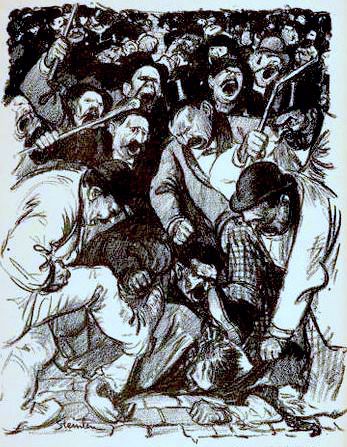
It’s the amazing fattening of the mass of the exploited that creates the increasing and logical ambition of the exploiters.
The kings of the mines, of the coalfields, and of gold would be wrong to worry. Their serfs’ resignation consecrates their authority. They no longer needs to claim that their power is be based on divine right, that decorative joke: their sovereignty is legitimated by popular consent. A workers’ plebiscite, consisting of patriotic adherence, declamatory platitudes or silent acquiescence assures the boss’s hold and the bourgeoisie’s reign
In this work we can recognize the artisan.
Be it in the mine or the factory, the Honest Worker, that sheep, has given the herd the mange.
The ideal of the supervisor has perverted the instincts of the people. A sports coat on Sunday, talking politics, voting...these are the hopes that take the place of everything. Odious daily labor awakens neither hatred nor rancor. The great party of the workers hates the lazybones who badly earns the money granted him by the boss.
Their heart belongs to their job.
They’re proud of their calloused hands.
However deformed the fingers, the yoke has done worse to the brain: the bumps of resignation, of cowardice, of respect have grown under the leather with the rubbing of the harness. Vain old workers wave their certificates: forty years in the same place! We hear them telling about this as they beg for bread in the courtyards.
“Have pity, ladies and gentlemen, on a sick old man, a brave worker, a good Frenchman, a former non-commissioned officer who fought in the war...Have pity, ladies and gentlemen.
It is cold: the windows remain closed. The old man doesn’t understand.
Teach the people! What else is needed? His poverty has taught him nothing. As long as there are rich and poor the latter will hitch themselves up so as to fill the service demanded. The worker’s neck is used to the harness. When still young and strong they are the only domestic beasts to not run wild in their shafts.
The proletarian’s special honor consists in accepting all those lies in whose name he is condemned to forced labor: duty, fatherland, etc. He accepts, hoping that by doing this he will raise himself into the bourgeois class. The victim makes himself an accomplice. The unfortunate talks of the flag, beats his chest, takes off his cap and spits in the air:
“I’m an honest worker.”
And it falls right back onto his face.


