In
a competitive society, where men struggle with one another for food and
shelter, what is more natural than that generosity, when it diminishes
the food and shelter of men other than he who is generous, should be
held an accursed thing? Wise old saws to the contrary, he who takes from
a man's purse takes from his existence. To strike at a man's food and
shelter is to strike at his life, and in a society organized on a
tooth-and-nail basis, such an act, performed though it may be under the
guise of generosity, is none the less menacing and terrible.
It is for this reason that a laborer is so fiercely hostile to another
laborer who offers to work for less pay or longer hours. To hold his
place (which is to live), he must offset this offer by another equally
liberal, which is equivalent to giving away somewhat from the food and
shelter he enjoys. To sell his day's work for two dollars instead of two
dollars and a half means that he, his wife, and his children will not
have so good a roof over their heads, such warm clothes on their backs,
such substantial food in their stomachs. Meat will be bought less
frequently, and it will be tougher and less nutritious; stout new shoes
will go less often on the children's feet; and disease and death will be
more imminent in a cheaper house and neighborhood.
Thus, the generous laborer,
giving more of a day's work for less return (measured in terms of food
and shelter), threatens the life of his less generous brother laborer,
and, at the best, if he does not destroy that life, he diminishes it.
Whereupon the less generous laborer looks upon him as an enemy, and, as
men are inclined to do in a tooth-and-nail society, he tries to kill the
man who is trying to kill him.
When
a striker kills with a brick the man who has taken his place, he has no
sense of wrong-doing. In the deepest holds of his being, though he does
not reason the impulse, he has an ethical sanction. He feels dimly that
he has justification, just as the home-defending Boer felt, though more
sharply, with each bullet he fired at the invading English. Behind
every brick thrown by a striker is the selfish "will to live" of himself
and the slightly altruistic will to live of his family. The
family-group came into the world before the state-group, and society
being still on the primitive basis of tooth and nail, the will to live
of the state is not so compelling to the striker as the will to live of
his family and himself.
In addition to the use of bricks, clubs, and bullets, the selfish
laborer finds it necessary to express his feelings in speech. Just as
the peaceful country-dweller calls the sea-rover a "pirate," and the
stout burgher calls the man who breaks into his strong-box a "robber,"
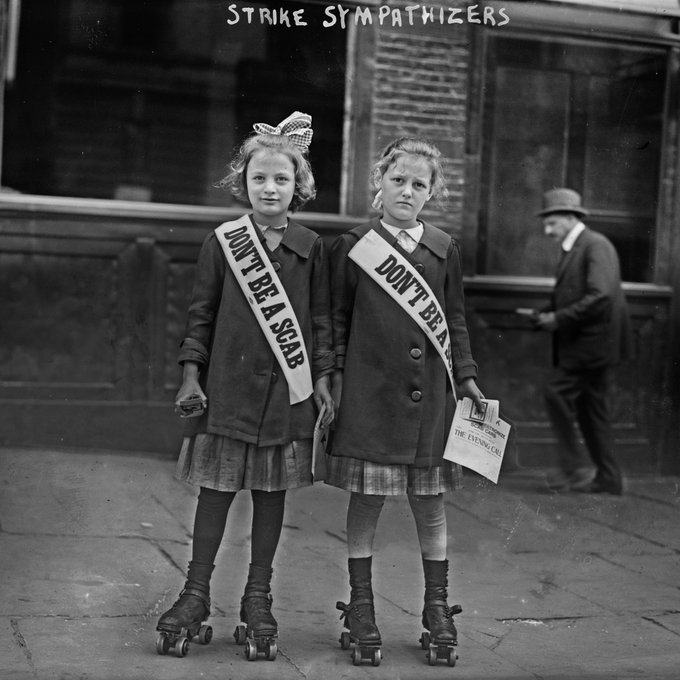
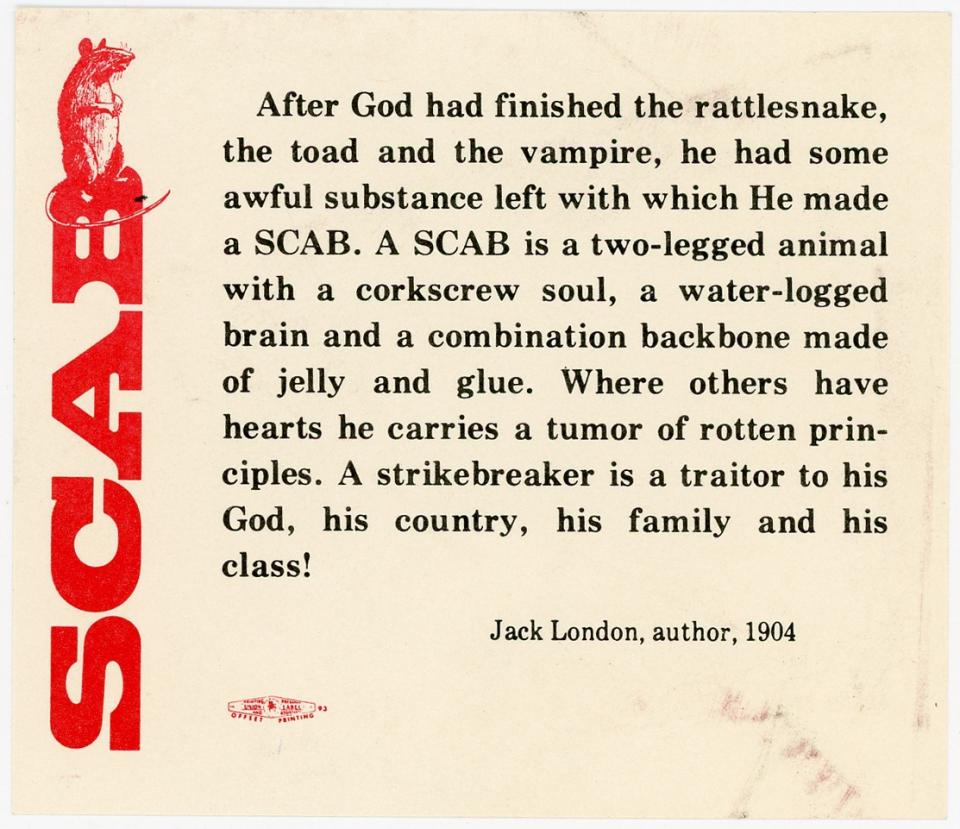
so the selfish laborer applies the opprobrious epithet "scab" to the
laborer who takes from him food and shelter by being more generous in
the disposal of his labor-power. The sentimental connotation of scab is
as terrific as that of " traitor" or "Judas," and a sentimental
definition would be as deep and varied as the human heart. It is far
easier to arrive at what may be called a technical definition, worded in
commercial terms, as, for instance, that a scab is one who gives more value for the same price than another.
The laborer who gives more time,
or strength, or skill, for the same wage, than another, or equal time,
or strength, or skill, for a less wage, is a scab. This generousness on
his part is hurtful to his fellow laborers, for it compels them to an
equal generousness which is not to their liking, and which gives them
less of food and shelter. But a word may be said for the scab. Just as
his act makes his rivals compulsorily generous, so do they, by fortune
of birth and training, make compulsory his act of generousness. He does
not scab because he wants to scab. No whim of the spirit, no burgeoning
of the heart, leads him to give more of his labor-power than they for a
certain sum.
It is because he
cannot get work on the same terms as they that he is a scab. There is
less work than there are men to do work. This is patent, else the scab
would not loom so large on the labor-market horizon. Because they are
stronger than he, or more skilled, or more fortunate, or more energetic,
it is impossible for him to take their places at the same wage. To take
their places he must give more value, must work longer hours, or
receive a smaller wage. He does so, and he cannot help it, for his will
to live is driving him on as well as they are being driven on by theirs,
and to live he must win food and shelter, which he can do only by
receiving permission to work from some man who owns a bit of land or
piece of machinery. And to receive permission from this man, he must
make the transaction profitable for him.
Viewed
in this light, the scab who gives more labor-power for a certain price
than his fellows is not so generous after all. He is no more generous
with his energy than the chattel slave and the convict laborer, who, by
the way, are the almost perfect scabs. They give their labor-power for
about the minimum possible price. But, within limits, they may loaf and
malinger, and, as scabs, are exceeded by the machine, which never loafs
and malingers, and which is the ideally perfect scab.
It is not nice to be a scab. Not only is it not in good social taste and
comradeship, but, from the standpoint of food and shelter, it is bad
business policy. Nobody desires to scab, to give most for least. The
ambition of every individual is quite the opposite,—to give least for
most; and as a result, living in a tooth-and-nail society, battle royal
is waged by the ambitious individuals. But in its most salient aspect,
that of the struggle over the division of a joint-product, it is no
longer a battle between individuals, but between groups of individuals.
Capital and labor apply themselves to raw material, make something
useful out of it, add to its value, and then proceed to quarrel over the
division of the added value. Neither cares to give most for least. Each
is intent on giving less than the other and on receiving more.
Labor combines into its unions;
capital into partnerships, associations, corporations, and trusts. A
group-struggle is the result, in which the individuals, as individuals,
play no part. The Brotherhood of Carpenters and Joiners, for instance,
serves notice on the Master Builders' Association that it demands an
increase of the wage of its members from $3.50 a day to $4.00, and a
Saturday half-holiday without pay. This means that the carpenters are
trying to give less for more. Where they received $21.00 for six full
days, they are endeavoring to get $22.00 for five days and a half,—that
is, they will work half a day less each week and receive a dollar more.
Also,
they expect the Saturday half-holiday to give work to one additional
man for each eleven previously employed. This last affords a splendid
example of the development of the group idea. In this particular
struggle the individual has no chance at all for life. The individual
carpenter would be crushed like a mote by the Master Builders'
Association, and like a mote the individual master builder would be
crushed by the Brotherhood of Carpenters and Joiners.
In
the group-struggle over the division of the joint-product, labor
utilizes the union with its two great weapons,—the strike and boycott;
while capital utilizes the trust and the association, the weapons of
which are the blacklist, the lockout, and the scab. The scab is by far
the most formidable weapon of the three. He is the man who breaks
strikes and causes all the trouble. Without him there would be no
trouble, for the strikers are willing to remain out peacefully and
indefinitely so long as other men are not in their places, and so long
as the particular aggregation of capital with which they are fighting is
eating its head off in enforced idleness.
But
both warring groups have reserve weapons up their sleeves. Were it not
for the scab, these weapons would not be brought into play. But the scab
takes the places of the strikers, who begin at once to wield a most
powerful weapon,—terrorism. The will to live of the scab recoils from
the menace of broken bones and violent death. With all due respect to
the labor leaders, who are not to be blamed for volubly asseverating
otherwise, terrorism is a well-defined and eminently successful policy
of the labor unions. It has probably won them more strikes than all the
rest of the weapons in their arsenal. This terrorism, however, must be
clearly understood. It is directed solely against the scab, placing him
in such fear for life and limb as to drive him out of the contest. But
when terrorism gets out of hand and inoffensive non-combatants are
injured, law and order threatened, and property destroyed, it becomes an
edged tool that cuts both ways. This sort of terrorism is sincerely
deplored by the labor leaders, for it has probably lost them as many
strikes as have been lost by any other single cause.
The
scab is powerless under terrorism. As a rule he is not so good or
gritty a man as the men he is displacing, and he lacks their fighting
organization. He stands in dire need of stiffening and backing. His
employers, the capitalists, draw their two remaining weapons, the
ownership of which is debatable, but which they for the time being
happen to control. These two weapons may be called the political and
judicial machinery of society. When the scab crumples up and is ready to
go down before the fists, bricks, and bullets of the labor-group, the
capitalist-group puts the police and soldiers into the field, and begins
a general bombardment of injunctions. Victory usually follows, for the
labor-group cannot withstand the combined assault of gatling guns and
injunctions.
But
it has been noted that the ownership of the political and judicial
machinery of society is debatable. In the Titanic struggle over the
division of the joint-product, each group reaches out for every
available weapon. Nor are they blinded by the smoke of conflict. They
fight their battles as coolly and collectedly as ever battles were
fought on paper. The capitalist-group has long since realized the
immense importance of controlling the political and judicial machinery
of society. Taught by gatlings and injunctions, which have smashed many
an otherwise successful strike, the labor-group is beginning to realize
that it all depends upon who is behind and who is before those weapons.
And he who knows the labor-movement knows that there is slowly growing
up and being formulated a clear, definite policy for the capture of the
political and judicial machinery.
This
is the terrible spectre which Mr. John Graham Brooks sees looming
portentously over the twentieth-century world. No man may boast a more
intimate knowledge of the labor-movement than he, and he reiterates
again and again the dangerous likelihood of the whole labor-group
capturing the political machinery of society. As he says in his recent
book*:
"It is not probable that employers can destroy unionism in the United
States. Adroit and desperate attempts will, however, be made, if we mean
by unionism the undisciplined and aggressive fact of vigorous and
determined organizations. If capital should prove too strong in this
struggle, the result is easy to predict. The employers have only to
convince organized labor that it cannot hold its own against the
capitalist manager, and the whole energy that now goes to the union will
turn to an aggressive political socialism. It will not be the harmless
sympathy with increased city and state functions which trade unions
already feel; it will become a turbulent political force bent upon using
every weapon of taxation against the rich."
This struggle not to be a scab,
to avoid giving more for less, and to succeed in giving less for more,
is more vital than it would appear on the surface. The capitalist and
labor groups are locked together in desperate battle, and neither side
is swayed by moral considerations more than skin-deep. The labor-group
hires business agents, lawyers, and organizers; and is beginning to
intimidate legislators by the strength of its solid vote, and more
directly, in the near future, it will attempt to control legislation by
capturing it bodily through the ballot-box. On the other hand, the
capitalist-group, numerically weaker, hires newspapers, universities,
and legislatures, and strives to bend to its need all the forces which
go to mould public opinion.
The
only honest morality displayed by either side is white-hot indignation
at the iniquities of the other side. The striking teamster complacently
takes a scab driver into an alley and with an iron bar breaks his arms
so that he can drive no more, but cries out to high heaven for justice
when the capitalist breaks his skull by means of a club in the hands of a
policeman. Nay, the members of a union will declaim in impassioned
rhetoric for the God-given right of an eight-hour day, and at the time
be working their own business agent seventeen hours out of the
twenty-four.
A
capitalist, such as the late Collis P. Huntington, and his name is
Legion, after a long life spent in buying the aid of countless
legislatures, will wax virtuously wrathful and condemn in unmeasured
terms "the dangerous tendency of crying out to the government for aid"
in the way of labor legislation. Without a quiver, a member of the
capitalist-group will run tens of thousands of pitiful child-laborers
through his life-destroying cotton factories, and weep maudlin and
Constitutional tears over one scab hit in the back with a brick. He will
drive a "compulsory" free contract with an unorganized laborer on the
basis of a starvation wage, saying, "Take it or leave it," knowing that
to leave it means to die of hunger; and in the next breath, when the
organizer entices that laborer into a union, will storm patriotically
about the inalienable rights of all men to work. In short, the chief
moral concern of either side is with the morals of the other side. They
are not in the business for their moral welfare, but to achieve the
enviable position of the non-scab who gets more than he gives.
But
there is more to the question than has yet been discussed. The labor
scab is no more detestable to his brother laborers than is the
capitalist scab to his brother capitalists. A capitalist may get most
for least in dealing with his laborers, and in so far be a non-scab; but
at the same time, in his dealings with his fellow capitalists, he may
give most for least and be the very worst kind of scab. The most heinous
crime an employer of labor can commit is to scab on his fellow
employers of labor. Just as the individual laborers have organized into
groups to protect themselves from the peril of the scab laborer, so have
the employers organized into groups to protect themselves from the
peril of the scab employer. The employers' federations, associations,
and trusts are nothing more or less than unions. They are organized to
destroy scabbing amongst themselves and to encourage scabbing amongst
others. For this reason they pool interests, determine prices, and
present an unbroken and aggressive front to the labor-group.
As
has been said before, nobody likes to play the compulsorily generous
role of scab. It is a bad business proposition on the face of it. And it
is patent that there would be no capitalist scabs if there were not
more capital than there is work for capital to do. When there are enough
factories in existence to supply, with occasional stoppages, a certain
commodity, the building of new factories, by a rival concern, for the
production of that commodity, is plain advertisement that that capital
is out of a job. The first act of this new aggregation of capital will
be to cut prices, to give more for less; in short, to scab, to strike at
the very existence of the less generous aggregation of capital, the
work of which it is trying to do.
No
scab capitalist strives to give more for less for any other reason than
that he hopes, by undercutting a competitor and driving that competitor
out of the market, to get that market and its profits for himself. His
ambition is to achieve the day when he shall stand alone in the field
both as buyer and seller, when he will be the royal non-scab buying most
for least, selling least for most, and reducing all about him, the
small buyers and sellers (the consumers and the laborers), to a general
condition of scabdom. This, for example, has been the history of Mr.
Rockefeller and the Standard Oil Company. Through all the sordid
economies of scabdom he has passed until to-day he is a most regal
non-scab. However, to continue in this enviable position, he must be
prepared at a moment's notice to go scabbing again. And he is prepared.
Whenever a competitor arises, Mr. Rockefeller changes about from giving
least for most, and gives most for least with such a vengeance as to
drive the competitor out of existence.
The
banded capitalists discriminate against a scab capitalist by refusing
him trade advantages, and by combining against him in most relentless
fashion. The banded laborers, discriminating against a scab laborer in
more primitive fashion, with a club, are no more merciless than the
banded capitalists.
Mr.
Casson tells of a New York capitalist, who withdrew from the Sugar
Union several years ago and became a scab. He was worth something like
twenty millions of dollars. But the Sugar Union, standing shoulder to
shoulder with the Railroad Union and several others, beat him to his
knees till he cried enough. So frightfully did they beat him that he was
obliged to turn over to his creditors his home, his chickens, and his
gold watch. In point of fact, he was as thoroughly bludgeoned by the
Federation of Capitalist Unions as ever scab workman was bludgeoned by a
labor union. The intent in either case is the same, to destroy the
scab's producing power. The labor scab with concussion of the brain is
put out of business, and so is the capitalist scab who has lost all his
dollars down to his chickens and his watch.
But
the role of scab passes beyond the individual. Just as individuals scab
on other individuals, so do groups scab on other groups. And the
principle involved is precisely the same as in the case of the simple
labor scab. A group, in the nature of its organization, is often
compelled to give most for least, and, so doing, to strike at the life
of another group. At the present moment all Europe is appalled by that
colossal scab, the United States. And Europe is clamorous with agitation
for a Federation of National Unions to protect her from the United
States. It may be noted, in passing, that in its prime essentials this
agitation in no wise differs from the trade union agitation among
workmen in any industry. The trouble is caused by the scab who is giving
most for least. The result of the American Scab's nefarious actions
will be to strike at the food and shelter of Europe. The way for Europe
to protect herself is to quit bickering among her parts and to form a
union against the Scab. And if the union is formed, armies and navies
may be expected to be brought into play in fashion similar to the bricks
and clubs in ordinary labor struggles.
In
this connection, and as one of many walking delegates for the nations,
M. Leroy-Beaulieu, the noted French economist, may well be quoted. In a
letter to the Vienna Tageblatt, he advocates an economic alliance among
the Continental nations for the purpose of barring out American goods.
an economic alliance, in his own language, "which may possibly and desirably develop into a political alliance."
It
will be noted in the utterances of the Continental walking delegates
that, one and all, they leave England out of the proposed union. And in
England herself the feeling is growing that her days are numbered if she
cannot unite for offense and defense with the great American Scab. As
Andrew Carnegie said some time ago, "The only course for Great Britain
seems to be reunion with her grandchild, or sure decline to a secondary
place, and then to comparative insignificance in the future annals of
the English-speaking race."
Cecil
Rhodes, speaking of what would have obtained but for the pig-headedness
of George III., and of what will obtain when England and the United
States are united, said, "No cannon would . . . be fired on either hemisphere but by permission of the English race."
It would seem that England, fronted by the hostile Continental Union
and flanked by the great American Scab, has nothing left but to join
with the Scab and play the historic labor-role of armed Pinkerton.
Granting the words of Cecil Rhodes, the United States would be enabled
to scab without let or hindrance on Europe, while England, as
professional strike-breaker and policeman, destroyed the unions and kept
order.
All this may appear
fantastic and erroneous, but there is in it a soul of truth vastly more
significant than it may seem. Civilization may be expressed to-day in
terms of trade unionism. Individual struggles have largely passed away,
but group struggles increase prodigiously. And the things for which the
groups struggle are the same as of old. Shorn of all subtleties and
complexities, the chief struggle of men, and of groups of men, is for
food and shelter. And, as of old they struggled with tooth and nail, so
to-day they struggle, with teeth and nails elongated into armies and
navies, machines, and economic advantages.
Under the definition that a scab is one who gives more value for the same price than another,
it would seem that society can be generally divided into the two
classes of the scabs and the non-scabs. But on closer investigation,
however, it will be seen that the non-scab is almost a vanishing
quantity. In the social jungle everybody is preying upon everybody else.
As in the case of Mr. Rockefeller, he who was a scab yesterday is a
non-scab to-day, and to-morrow may be a scab again.
The
woman stenographer or bookkeeper who receives forty dollars per month
where a man was receiving seventy-five is a scab. So is the woman who
does a man's work at a weaving machine, and the child who goes into the
mill or factory. And the father, who is scabbed out of work by the wives
and children of other men, sends his own wife and children to scab in
order to save himself.
When a
publisher offers an author better royalties than other publishers have
been paying him, he is scabbing on those other publishers. The reporter
on a newspaper who feels he should be receiving a larger salary for his
work, says so, and is shown the door, is replaced by a reporter who is a
scab; whereupon, when the belly-need presses, the displaced reporter
goes to another paper and scabs himself. The minister who hardens his
heart to a call, and waits for a certain congregation to offer him say
five hundred a year more, often finds himself scabbed upon by another
and more impecunious minister; and the next time it is his turn
to Scab while a brother minister is hardening his heart to a call. The
scab is everywhere. The professional strike-breakers, who, as a class,
receive large wages, will scab on one another, while scab unions are
even formed to prevent scabbing upon scabs.
There
are non-scabs, but they are usually born so, and are protected by the
whole might of society in the possession of their food and shelter. King
Edward is such a type, as are all individuals who receive hereditary
food-and-shelter privileges, such as the present Duke of Bedford, for
instance, who yearly receives $75,000 from the good people of London
because some former king gave some former ancestor of his the market
privileges of Covent Garden. The irresponsible rich are likewise
non-scabs, and, by them is meant that coupon-clipping class which hires
its managers and brains to invest the money usually left it by its
ancestors.
Outside these
lucky creatures, all the rest, at one time or another in their lives,
are scabs, at one time or another are engaged in giving more for a
certain price than any one else. The meek professor in some endowed
institution, by his meek suppression of his convictions, is giving more
for his salary than the other more outspoken professor gave, whose chair
he occupies. And when a political party dangles a full dinner-pail in
the eyes of the toiling masses. it is offering more for a vote than the
dubious dollar of the opposing party. Even a money-lender is not above
taking a slightly lower rate of interest and saying nothing about it.
Such
is the tangle of conflicting interests in a tooth-and-nail society that
people cannot avoid being scabs, are often made so against their
desires, and unconsciously. When several trades in a curtain locality
demand and receive an advance in wages, they are unwittingly making
scabs of their fellow laborers in that district who have received no
advance in wages. In San Francisco the barbers, laundry workers, and
milk-wagon drivers received such an advance in wages. Their employers
promptly added the amount of this advance to the selling price of their
wares. The price of shaves, of washing, and of milk went up. This
reduced the purchasing power of the unorganized laborers, and, in point
of fact, reduced their wages and made them greater scabs.
Because
the British laborer is disinclined to scab, that is, because he
restricts his output in order to give less for the wage he receives, it
is to a certain extent made possible for the American capitalist, who
receives a less restricted output from his laborers, to play the scab on
the English capitalist. As a result of this (of course, combined with
other causes), the American capitalist and the Amencan laborer are
striking at the food and shelter of the English capitalist and laborer.
The
English laborer is starving to-day because, among other things, he is
not a scab. He practices the policy of "Ca' Canny," which may be defined
as "go easy." In order to get most for least, in many trades he
performs but from one fourth to one sixth of the labor he is well able
to perform. An instance of this is found in the building of the
Westinghouse Electric Works at Manchester. The British limit per man was
400 bricks per day. The Westinghouse Company imported a "driving"
American contractor aided by half-a-dozen "driving" American foremen,
and the British bricklayer swiftly attained an average of 1800 bricks
per day, with a maximum of 2500 bricks for the plainest work.
But
the British laborer's policy of Ca' Canny, which is the very honorable
one of giving least for most, and which is likewise the policy of the
English capitalist, is nevertheless frowned upon by the English
capitalist whose business existence is threatened by the great American
Scab. From the rise of the factory system, the English capitalist gladly
embraced the opportunity, wherever he found it, of giving least for
most. He did it all over the world wherever he enjoyed a market
monopoly, and he did it at home, with the laborers employed in his
mills, destroying them like flies till prevented, within limits, by the
passage of the Factory Acts. Some of the proudest fortunes of England
to-day may trace their origin to the giving of least for most to the
miserable slaves of the factory towns. But at the present time the
English capitalist is outraged because his laborers are employing
against him precisely the same policy he employed against them, and
which he would employ again did the chance present itself.
Yet
Ca' Canny is a disastrous thing to the British laborer. It has driven
ship-building from England to Scotland, bottle-making from Scotland to
Belgium, flint-glass-making from England to Germany, and to-day it is
steadily driving industry after industry to other countries. A
correspondent from Northampton wrote not long ago: "Factories are
working half and third time.... There is no strike, there is no real
labor trouble, but the masters and men are alike suffering from sheer
lack of employment. Markets which were once theirs are now American." It
would seem that the unfortunate British laborer is 'twixt the devil and
the deep sea. If he gives most for least, he faces a frightful slavery
such as marked the beginning of the factory system. If he gives least
for most, he drives industry away to other countries, and has no work at
all.
But the union laborers
of the United States have nothing to boast of, while, according to their
trade-union ethics, they have a great deal of which to be ashamed. They
passionately preach short hours and big wages, the shorter the hours
and the bigger the wages the better. Their hatred for a scab is as
terrible as the hatred of a patriot for a traitor, of a Christian for a
Judas. And in the face of all this they are as colossal scabs as the
United States is a colossal scab. For all of their boasted unions and
high labor-ideals, they are about the most thorough-going scabs on the
planet.
Receiving $4.50 per
day, because of his proficiency and immense working power, the American
laborer has been known to scab upon scabs (so called) who took his place
and received only $.90 per day for a longer day. In this particular
instance, five Chinese coolies, working longer hours, gave less value
for the price received from their employer than did one American
laborer.
It
is upon his brother laborers overseas that the American laborer most
outrageously scabs. As Mr. Casson has shown, an English nailmaker gets
$3.00 per week, while an American nailmaker gets $30.00. But the English
worker turns out 200 pounds of nails per week, while the American turns
out 5500 pounds. If he were as "fair" as his English brother, other
things being equal, he would be receiving, at the English worker's rate
of pay. $82.50. As it is, he is scabbing upon his English brother to the
tune of $79.50 per week. Dr. Schultze-Gaevernitz has shown that a
German weaver produces 466 yards of cotton a week at a cost of .303 per
yard, while an American weaver produces 1200 yards at a cost of .02 per
yard.
But, it may be
objected, a great part of this is due to the more improved American
machinery. Very true; but, none the less, a great part is still due to
the superior energy, skill, and willingness of the American laborer. The
English laborer is faithful to the policy of Ca' Canny. He refuses
point blank to get the work out of a machine that the New World scab
gets out of a machine. Mr. Maxim, observing a wasteful hand-labor
process in his English factory, invented a machine which he proved
capable of displacing several men. But workman after workman was put at
the machine, and without exception they turned out neither more nor less
than a workman turned out by hand. They obeyed the mandate of the union
and went easy, while Mr. Maxim gave up in despair. Nor will the British
workman run machines at as high speed as the American, nor will he run
so many. An American workman will "give equal attention simultaneously
to three, four, or six machines or tools, while the British workman is
compelled by his trade union to limit his attention to one, so that
employment may be given to half-a-dozen men."
But
to scabbing, no blame attaches itself anywhere. All the world is a
scab, and with rare exceptions, all the people in it are scabs. The
strong, capable workman gets a job and holds it because of his strength
and capacity. And he holds it because out of his strength and capacity
he gives a better value for his wage than does the weaker and less
capable workman. Therefore he is scabbing upon his weaker and less
capable brother workman. This is incontrovertible. He is giving more
value for the price paid by the employer.
The
superior workman scabs upon the inferior workman because he is so
constituted and cannot help it. The one, by fortune of birth and
upbringing, is strong and capable; the other, by fortune of birth and
upbringing, is not so strong or capable. It is for the same reason that
one country scabs upon another. That country which has the good fortune
to possess great natural resources, a finer sun and soil, unhampering
institutions, and a deft and intelligent labor class and capitalist
class, is bound to scab upon a country less fortunately situated. It is
the good fortune of the United States that is making her the colossal
scab, just as it is the good fortune of one man to be born with a
straight back while his brother is born with a hump.
It
is not good to give most for least, not good to be a scab. The word has
gained universal opprobrium. On the other hand, to be a non-scab, to
give least for most, is universally branded as stingy, selfish, and
unchristian-like. So all the world, like the British workman, is 'twixt
the devil and the deep sea. It is treason to one's fellows to scab, it
is treason to God and unchristian-like not to scab.
Since
to give least for most and to give most for least are universally bad,
what remains? Equity remains, which is to give like for like, the same
for the same, neither more nor less. But this equity, society, as at
present constituted, cannot give. It is not in the nature of present-day
society for men to give like for like, the same for the same. And as
long as men continue to live in this competitive society, struggling
tooth and nail with one another for food and shelter, (which is to
struggle tooth and nail with one another for life), that long will the
scab continue to exist. His will to live will force him to exist. He may
be flouted and jeered by his brothers, he may be beaten with bricks and
clubs by the men who by superior strength and capacity scab upon him as
he scabs upon them by longer hours and smaller wages, but through it
all he will persist, going them one better, and giving a bit more of
most for least than they are giving.
*Footnote refers to John Graham Brooks' The Social Unrest. New York: The Macmillan Co. 1903
___________________________
Bloggers note, at this time in the United Kingdom there is increasing industrial unrest over a crisis in the cost of living, cuts to investment, and plans to enact mass lay-offs in multiple industries.This archive was created to celebrate freedom of art and information, and as such it also supports the freedom of association and combinations of workers everywhere. The same system that restricts access to art and knowledge is the same that exploits workers and impoverishes communities. Don't be a scab.